Thank you! Your submission has been received!
Oops! Something went wrong while submitting the form.
Thank you! Your submission has been received!
Oops! Something went wrong while submitting the form.



"Agentic AI" is one of the fastest-growing, most inconsistently defined terms in AI hiring right now. Buyers often start looking for an AI agent developer before they can say precisely what separates the role from a GenAI engineer or a chatbot builder, and the market's own job titles don't help much. Demand is real: job postings mentioning agentic AI skills grew more than 280% between 2024 and 2025, reaching roughly 90,000 US listings. Figuring out what you actually need, on your own, costs time, on top of the median 62-day US technical-role time-to-fill. Hire an AI agent developer through KDCI instead, and you get a pre-vetted specialist, matched in 7–14 days, at a flat monthly rate.
An AI agent developer designs and ships software agents that plan multi-step tasks, decide which tools or APIs to call, maintain memory and state across steps, and act with limited human review per step. That's a meaningfully different job than a single-turn GenAI feature, which takes one prompt and returns one response with no ongoing state or autonomous decision-making.
The work involves tool-calling and function-calling patterns, orchestration frameworks like LangGraph or CrewAI-style multi-agent coordination, and evaluation loops built specifically for non-deterministic, multi-step behavior, since traditional QA doesn't map cleanly onto a system that can take a different path every run.
Worth noting: the market uses "AI agent developer" and "AI agent engineer" interchangeably, the same developer-versus-engineer naming looseness already resolved once for this cluster on our guide to hiring an AI engineer. If you're still narrowing down which AI role you actually need, that page is the broader starting point this one specializes away from.
"AI agent developer" is the newest, most specialized builder seat in this cluster, and it sits alongside several adjacent roles that own different territories.
One disambiguation worth stating plainly, since "AI agent" gets used two other ways that have nothing to do with this page: some vendors market an ordinary customer-support chatbot as an "AI agent," which is a different discipline covered by our guide to hiring a conversational AI developer. And "agent" is also just the word for a human role, insurance, travel, real estate, that AI tools are augmenting, not a developer title at all. Neither belongs here.
One more line worth drawing, since the two get confused for a related reason: an AI Integration Specialist takes an AI tool that already exists — including an agent this role built — and wires it safely into the systems a business already runs, like Salesforce or ServiceNow. This role builds the agent's decision-making; that one connects it to the real world once it's built.
As teams push further, some eventually need a Forward Deployed Engineer for client-embedded implementation work, or a senior AI Solutions Architect for cross-team standards. Both are roles KDCI is actively tracking demand for.
Demand is outpacing the market's ability to price or define this role consistently. Enterprise adoption is real: a majority of surveyed companies now report AI agents deployed somewhere in the business, though the share actually running agents at scale in production is considerably smaller, worth keeping in mind before treating "adoption" numbers as evidence everyone has this figured out already.
On compensation, one caution matters more than any single number: ZipRecruiter's aggregate average for "AI agent developer" sits at roughly $48,000 a year, a figure that's almost certainly diluted by unrelated customer-service "agent" job postings sharing the same title text, not real technical agent-building work. Specialized agent-building compensation instead tracks in line with, or above, standard senior AI-engineering pay, in the same range as senior generative AI engineering roles more broadly. Treat any single aggregate salary figure for this specific title with real skepticism until it's been checked against actual job descriptions, not just a title match.
Time to fill compounds the confusion. The median US technical role takes 62 days to fill. KDCI places pre-vetted AI agent developers in 7–14 days instead, at a flat monthly rate roughly a third less than a comparable US hire. If you've already decided offshore is the right model, our guide to hiring an offshore AI engineer covers that channel in more depth.
Screen for production experience with agent-orchestration patterns specifically: planning loops, tool and function-calling, multi-agent coordination, not just general familiarity with an LLM API. Hands-on evaluation and observability for non-deterministic, multi-step behavior is a genuinely emerging and differentiating skill right now, since it's a different discipline from testing a system that returns the same output every time. Solid GenAI and LLM fundamentals underneath, prompting and retrieval, matter too, without requiring a deep ML-research background.
If the req in front of you is still titled "Prompt Engineer," this is often where that work actually lands now — see our breakdown of prompt engineer hiring for the other two places it might land instead.
On certifications: one weak signal among several, not a substitute for a real skills assessment, the same treatment we give AI engineer certifications on the sibling page. And one honest line worth stating directly: KDCI doesn't build agents on a project basis. This page is for hiring the person who will.
Every candidate is pre-vetted via an internal skills assessment confirming deployment readiness, applied here specifically to agent-orchestration competency and tool-use evaluation skill, not just general AI or ML background.
You share the scope, KDCI matches you with a shortlist of pre-vetted candidates, you interview on your own criteria, and your pick starts within 7–14 days.
This is a hyped, inconsistently defined title right now, and the value here is cutting through that with a grounded, concrete vetting bar rather than chasing the hype. Pre-vetted talent, matched in 7–14 days, at a flat monthly rate roughly a third less than a comparable US hire.
Hire Your Vetted AI Agent Developer Tell us what you're building, and we'll match you with a pre-vetted AI agent developer ready to start in 7–14 days. Speak with an outsourcing specialist to get started.
An AI agent developer builds systems that plan multi-step tasks, decide which tools to call, and act with limited human review across steps. A chatbot, even one marketed as an "AI agent," typically handles single-turn conversations rather than autonomous, multi-step decision-making.
Not quite. An AI engineer is the generalist who ships AI-powered features end to end. A generative AI engineer owns LLM and RAG-application depth. An AI agent developer specializes further into autonomous, tool-using, multi-step systems, often built on top of generative AI foundations. See the comparison table above for the full breakdown.
No. It's one weak signal among several, not a substitute for a real skills assessment focused on production experience with agent-orchestration patterns.
7–14 days, pre-vetted, against a median US technical-role benchmark of 62 days.
Roughly a third less than a comparable US hire, at a flat monthly rate.


Ask three vendors what AI agent development services cost, and you can get quotes from $15,000 to well past $500,000 for what sounds like the same project. The spread is not vendor games. It is that "AI agent" covers wildly different systems, from a single tool-using assistant to a multi-agent platform wired into an entire tech stack. This blog does two things: it breaks down the real cost and scope behind AI agent development services, and it is upfront that KDCI's own model is a different one. KDCI does not deliver agent projects. It places an embedded developer who owns the work. If you are still mapping the wider decision, start with AI developer hiring.
An AI agent development vendor scopes, builds, and typically either hands off or maintains, under a separate contract, a custom agentic system. In practice that means three things: the planning and orchestration logic that lets the agent decide what to do next, the tool-calling and integrations that let it act inside your systems, and the evaluation work that keeps non-deterministic behavior in check. That last part is where agent projects differ most from ordinary software: an agent can take a different path every run, and someone has to test for that.
Whether the vendor calls itself an agency, a firm, or a development company, the engagement shape is the same: a scoped project with a start date, a deliverable, and a price.
One clarification, since the term is overloaded. Here, an AI agent means an autonomous, tool-using software system, not a customer-support chatbot marketed as an "AI agent" (chatbot development services or a conversational AI developer), and not the human agent professions in insurance, travel, or real estate.
Cost is the first real data point here, so start with the range. Published 2026 pricing guides put the numbers in four rough tiers.
Two things drive those numbers, and neither is vendor markup: how autonomous the agent is, and how many systems it has to touch. A read-only research agent is far cheaper than one that books, sends, or pays. So a quote is only meaningful once you know which tier it matches; most mid-market builds land between $40,000 and $150,000.
The build is also not the whole bill. Maintenance runs roughly 15 to 30% of the build cost every year, and model and infrastructure costs add about $500 to $15,000 a month depending on usage. Agents need retuning as models and tools change, so year one always costs more than the build quote.
Demand is real, even where the headline numbers disagree. Grand View Research puts the AI agents market at $10.9 billion in 2026, growing toward $182.9 billion by 2033, a 49.6% annual rate, though estimates run anywhere from roughly $50 billion to $200 billion by the early 2030s. Gartner projects 40% of enterprise applications will include task-specific agents by the end of 2026, up from under 5% a year earlier. Treat the biggest figure you will see, Gartner's roughly $201.9 billion agentic-spending estimate, with care: it counts agentic capability embedded across enterprise software, not standalone agent projects, so it is not the market you are shopping in.
For a single, bounded build, project-based AI agent development services can be the right call. The friction shows up afterward. Because the engagement is scoped as a project, most changes, a retrain, a new tool integration, a shift in business logic, tend to come back as a new statement of work and a new cost. Agents are not build-once systems. They drift as the models and tools underneath them change, which means the work is ongoing by nature.
That is the gap the embedded model fills. Instead of commissioning a project, you outsource the AI agent development to a developer who joins your own team.
KDCI works the second way: a pre-vetted developer joins your team in 7 to 14 days, owns iteration, evaluation, and maintenance as a standing responsibility, and bills a flat monthly rate about a third less than a comparable local hire.
To be clear about the boundary: KDCI does not quote or compete on project-based build pricing. If what you actually want is agent strategy or a broader assessment, that is AI consulting services. For non-agent-specific build-versus-hire questions, see AI development services. And if you are ready to bring the work in-house rather than commission it, you can hire an AI agent developer.
The evaluation criteria are mostly the same whether you are picking a vendor or a hire, and none of them is a logo or a ranking. Look for real experience with orchestration frameworks and tool-calling patterns, not slideware. Ask how they handle evaluation and observability for behavior that is non-deterministic across multiple steps, because that is where agents quietly fail in production. Favor a track record of shipped integrations over polished demos, since a demo proves nothing about a live system wired into your data.
The question that separates the two models most clearly is the last one: who owns this system after it ships? A project vendor's answer is usually "you do, or we do under a new contract." An embedded hire's answer is "I do, as part of the team." How a candidate or a vendor answers tells you which model you are really buying.
KDCI's developers are pre-vetted through an internal skills assessment that confirms deployment readiness. For an AI agent developer, that assessment covers agent-orchestration competency and hands-on tool-use and evaluation skill, the same bar applied on the AI agent developer role itself. The point is simple: you are not the first test of whether someone can actually do the work.
The process is built for speed without skipping the checks. You share the role and the context, KDCI returns a shortlist of pre-vetted candidates, you interview the ones you want, and the developer you pick starts on your team. That runs about 7 to 14 days, against US technical roles that now take closer to 60 days to fill on average, and longer still for specialized AI work.
The case for hiring comes down to ownership. A project ends at delivery; an agent's work does not. When the developer who built the system is on your team, iteration, retuning, and new integrations are just the job, not a fresh estimate. You also get there fast, in about 7 to 14 days, at a flat monthly rate about a third below a comparable local hire. For anything beyond a single bounded build, that ongoing ownership is usually the better fit.
Ready to own the work instead of commissioning it? Embed an AI agent developer on your team in 7 to 14 days, pre-vetted for agent orchestration, and keep iteration and maintenance in-house instead of back on a statement of work.
AI development covers building any AI-powered system, from a predictive model to a computer vision pipeline to a single-turn chatbot. AI agent development is a subset of that: it specifically builds systems that plan, take multi-step action, call tools, and operate with a degree of autonomy toward a goal. Every AI agent is an AI system, but not every AI system is an agent, most classification models and static chatbots aren't.
AI agent development services deliver a custom agent as a scoped, one-time project. Hiring an AI agent developer puts a person on your team who builds the agent and stays to run and improve it. The first fits a bounded build; the second fits ongoing work.
In 2026, project builds run from about $10,000 for a single-task prototype to $500,000 or more for an enterprise multi-agent system, with most mid-market builds between $40,000 and $150,000. Maintenance then adds roughly 15 to 30% of the build cost each year.
No. KDCI does not build agents on a project basis or quote project pricing. It places a pre-vetted AI agent developer on your team to own the build and the ongoing work instead.
Yes. Consulting is about strategy and direction rather than building the system itself. KDCI does not offer standalone agent consulting; for that broader question, see AI consulting services.
Yes, and it is one of the most common reasons teams hire rather than re-commission. An embedded developer can take over an existing agent and own its retuning, evaluation, and new integrations, the ongoing-ownership gap a one-time build leaves open.

Enterprises want their LLM to answer questions grounded in their own proprietary data: support docs, internal wikis, contracts, product catalogs, not just what the model learned during training. Getting that right in production takes chunking strategy, embedding choices, vector infrastructure, and ongoing retrieval tuning that most teams don't have in-house. The RAG market's growth reflects how mainstream this task has become, not a research curiosity anymore.
This page covers what RAG development services actually involve, how RAG-as-a-service platforms and project-based builds compare to embedded staffing, and KDCI's honest answer: real guidance on the build question, with a case for why ongoing ownership beats a one-time handoff.
RAG, retrieval-augmented generation, grounds an LLM's responses in an organization's own data by retrieving relevant content at query time and feeding it into the model as context, rather than relying solely on the model's training data. Enterprise RAG, RAG consulting, and enterprise RAG solutions all describe the same underlying concept: building a retrieval system tuned to a specific organization's own data and requirements, not a generic implementation. Common use cases include internal knowledge search, customer support grounded in real documentation, and compliance-safe question answering over regulated content.
Worth drawing the boundary early: RAG is specifically about grounding a model in your own data, not the broader prompt-application and agent-building work that sits alongside it, which is generative AI engineers' territory. And if the actual need is the customer-facing chat interface itself rather than the retrieval system underneath it, our breakdowns of chatbot development services and ChatGPT development services cover that build directly.
The other adjacent boundary worth naming: RAG changes what knowledge a model can retrieve, not the model's own underlying behavior. If the actual gap is behavior, tone, or domain-specific reasoning that retrieval can't fix, our guide to LLM fine-tuning services covers that different lever directly.
Four real paths exist here, and they solve different problems.
Building in-house gives full control, but it's the slowest path to launch, and it requires hiring or reallocating scarce ML and data engineering talent that most teams are already stretched thin on.
RAG-as-a-service platforms are a real, fast-to-launch model: a vendor operates shared retrieval infrastructure you plug your data into. It's genuinely the right call for straightforward use cases. But an enterprise with proprietary, sensitive, or deeply domain-specific data, regulated industries, internal-only knowledge bases, usually needs retrieval and security tuned to its own stack, which a generic hosted platform doesn't fully provide out of the box. KDCI doesn't offer this model.
Project-based development services get you a built system, handed off at the end of the engagement. That's a real option for a bounded, well-scoped build. The gap: a handed-off system needs continuous retrieval tuning as the underlying data and usage patterns evolve, and a one-time build doesn't cover that. KDCI doesn't run project-based development engagements either.
Dedicated staffing is KDCI's model: an embedded, pre-vetted RAG engineer who owns the system on an ongoing basis, matched in 7–14 days, at a flat monthly rate roughly a third less than a comparable US hire. If you've already decided offshore is the right model and want a deeper look at that specific channel, our guide to hiring an offshore AI engineer covers it in more detail.
A production RAG system rests on a handful of decisions that determine whether it actually works once real users touch it. Chunking strategy determines how source documents get split before embedding: too large and retrieval gets imprecise, too small and context gets lost. Embedding model selection shapes how well the system captures meaning versus just keywords. Vector store choice affects both retrieval speed and how the system scales as the knowledge base grows. Hybrid retrieval, combining keyword and semantic search rather than relying on vector similarity alone, catches queries that pure semantic matching misses. Evaluation loops for retrieval quality are what catch a system quietly degrading before customers notice.
The data pipeline and ETL work feeding any RAG system, the general-purpose ingestion layer, is a different discipline from the retrieval-specific tuning above. That's data engineering staffing's territory; this page covers what happens once clean data reaches the retrieval layer.
A few practices separate systems that hold up in production from ones that quietly degrade. Version and evaluate retrieval quality continuously, not just at launch, since both the underlying data and how users query it shift over time. Enforce document-level access control inside the retrieval layer itself, not as an afterthought bolted onto the interface. Prefer hybrid search over pure vector similarity for factual or legal content, where a near-miss retrieval can matter as much as a wrong one. And treat retrieval evaluation as an ongoing operational practice, not a one-time QA pass before launch.
The RAG market is projected to grow from roughly $1.94 billion in 2025 to $9.86 billion by 2030, a 38.4% CAGR, evidence of how fast enterprise demand for this capability is scaling. Market-size estimates for RAG vary significantly across research firms depending on how broadly the category is defined; the figure above is cited consistently to one source rather than the largest number found in research. The adjacent vector database market, the infrastructure RAG systems run on, is projected to grow from about $2.65 billion in 2025 to $8.95 billion by 2030.
RAG engineer compensation needs a caveat. ZipRecruiter's aggregate average sits at $90,511 a year, but that figure blends several distinct underlying roles, retrieval engineers, applied LLM engineers, and platform engineers, all posted under one title. Specialized AI-staffing data breaks the real bands out: $130,000–$175,000 for mid-level, $195,000–$290,000 for senior engineers actually doing production retrieval work. One specialized RAG staffing source also reports senior RAG searches closing in 5 to 9 weeks specifically, a useful contrast alongside the median 62-day US technical-role benchmark more broadly. KDCI matches pre-vetted RAG engineers in 7–14 days instead, at a flat monthly rate roughly a third less than a comparable US hire.
By the Numbers
Every candidate is pre-vetted via an internal skills assessment confirming deployment readiness, applied here to retrieval-pipeline design, vector infrastructure, and evaluation practice specifically, not just familiarity with a RAG framework.
You share the scope, KDCI matches you with a shortlist of pre-vetted candidates, you interview on your own criteria, and your pick starts within 7–14 days.
The honest build-vs-hire framing above holds regardless of which delivery model you started considering: RAG systems need continuous retrieval tuning as data and usage evolve, which is exactly what an embedded engineer provides and a platform or project-based build doesn't. Pre-vetted talent, matched in 7–14 days, at a flat monthly rate roughly a third less than a comparable US hire. Whether RAG is the only AI capability you need or one piece of a broader build, the same pre-vetted approach applies across our AI development services and our complete guide to AI developer hiring.
Get Your Vetted RAG Engineering Team Tell us what you're building, and we'll match you with a pre-vetted RAG engineer ready to start in 7–14 days. Speak with an outsourcing specialist to get started.
RAG development services build a custom system tuned to your own data and requirements. RAG-as-a-service is a hosted platform running shared retrieval infrastructure you plug your data into, faster to launch but less tuned to proprietary or highly domain-specific needs.
Only staffing. KDCI places an embedded, pre-vetted RAG engineer who owns the system on an ongoing basis. KDCI does not run project-based development engagements or operate a hosted RaaS platform.
Chunking strategy, embedding model selection, vector store choice, hybrid retrieval combining keyword and semantic search, and ongoing evaluation loops for retrieval quality. See the architecture section above for the full breakdown.
7–14 days, pre-vetted, against a median US technical-role benchmark of 62 days, with specialized senior RAG searches often running longer still.
Roughly a third less than a comparable US hire, at a flat monthly rate. Note that aggregate RAG engineer salary data tends to understate true specialized retrieval-engineering pay, since it blends several distinct roles under one title.

If your engineering team spends more of the week firefighting deployments than shipping features, the codebase is rarely the cause. Pipelines fail without warning, cloud environments get configured by hand, and once something ships, nobody clearly owns keeping it running.
That gap widens as the stack grows, and it gets more expensive every sprint it stays open. A dedicated DevOps engineer closes it, and KDCI can place one on your team in 7–14 days. Below is what the role covers, where it stops and adjacent titles begin, and which hiring channel fits your timeline and budget.
A DevOps engineer owns the systems that move code from a repository into production and keep it running there. In practice, the work covers five areas:
The same discipline that keeps a web app deploying cleanly keeps model deployment pipelines and GPU infrastructure running under load. Workflow and business-process automation sits outside this role, along with QA and test automation, which is the work you would hire Automation Engineers for.
If you are still mapping the seats on your team, KDCI's guide to AI team structure shows where DevOps sits alongside the modeling and data roles around it.
DevOps owns the path to production, Automation Engineers own business workflows and test coverage, SRE owns measured reliability, and MLOps applies DevOps practice to model pipelines. Here is how they compare on the details that decide which one you post:
SRE is a distinct discipline built around formal reliability targets, and it usually exists as its own function inside larger engineering organizations. Smaller teams get most of the same benefit from a DevOps engineer who treats monitoring and incident response as part of the job.
MLOps runs on the same tooling and habits as DevOps, applied to a different payload. It handles model artifacts, retraining schedules, and serving infrastructure, where a DevOps engineer handles general application code. The modeling work upstream of that pipeline is what you would hire Machine Learning Engineers for.
A DevOps engineer in the US averages roughly $134,000 a year in base pay, and the real cost to your budget lands closer to $180,000 once employer-side benefits are counted. The full picture looks like this:
That 62-day median holds across most AI Developer hiring, and DevOps sits at the competitive end of it. Market growth of 21% a year means the candidates who clear a technical screen are usually fielding several offers, which is why a traditional search stretches past the two-month mark.
Dedicated staffing fits most teams that want DevOps ownership inside their own process. The other three channels each solve a narrower problem: direct hire builds permanent headcount, freelancers handle scoped projects, and a managed service hands your infrastructure to an outside vendor.
A managed service and a DevOps consultant both work on your infrastructure from the outside, which is useful for a one-off migration or an architecture review. Dedicated staffing is the better fit when the work is continuous and you want the knowledge to stay in your team.
Screen for depth in the one cloud platform your stack runs on, then test the areas below with specifics rather than resume keywords. A strong candidate can walk you through:
These are the criteria KDCI screens against before a candidate reaches your shortlist.
Every DevOps engineer KDCI places completes an internal skills assessment that confirms deployment readiness before they reach your shortlist. The assessment covers CI/CD proficiency, infrastructure-as-code fluency, and depth in the cloud platform you run. Resume claims alone never get a candidate onto your list.
Hiring through KDCI runs from first call to start date in about two weeks. It opens with an intake conversation, where KDCI maps your stack, your pipeline tooling, and the specific ownership gaps you need filled.
From there you receive a shortlist of pre-vetted candidates matched to those requirements and interview them directly. Every candidate on that list has already cleared the deployment-readiness assessment, so the only question left on your side is which one fits your team.
For AI and ML teams, the deployment pipeline is usually what separates a model that works in a notebook from one that works in production. Someone has to own that pipeline by name, and the longer the seat stays empty, the more of your engineers' week it takes.
KDCI fills that seat with an engineer who works inside your repo, your tooling, and your process, at a cost that fits a growing team's budget. Tell us what your stack looks like and where the gaps sit, and you will have candidates to interview this week.
One engineer covers a single production environment and a handful of services. You need a second once you run multiple regions, require round-the-clock on-call, or have compliance rules that demand separation of duties.
You do. The engineer works inside your AWS, Azure, or GCP accounts using access you provision through your own identity provider, and offboarding is a matter of revoking it.
Coverage hours are agreed at intake. Tell KDCI when you deploy and what response time you need, and candidates are matched against that requirement alongside the technical screen.
Make documentation a deliverable from week one: infrastructure defined in code, runbooks for common failures, and recorded architecture decisions. Ask candidates how they documented their last environment, since the strong ones already work this way.

Most companies making their first AI hire don't yet know whether they need a machine learning engineer, a generative AI engineer, or a data scientist. They just know they need someone who can ship AI-powered features. Figuring that out alone costs time: the median technical role in the US takes 62 days to fill, and that's before accounting for the extra weeks spent deciding which title to even search for. Hire an AI engineer through KDCI instead, and you get a pre-vetted generalist, matched in 7-14 days, at a flat monthly rate roughly a third below a comparable US hire, plus a clear path to a narrower specialist if that turns out to be what you actually need.
An AI engineer builds and deploys AI-powered features end to end: integrating models, whether built in-house or accessed via API, building the surrounding application logic, and shipping the result to production. The role sits closer to software engineering than to research. A typical job description covers things like wiring a model into an existing product, handling the edge cases a model gets wrong, and making sure the feature actually holds up once real users touch it, not just in a demo. It's the generalist entry point into AI hiring, and the right first hire when your scope is still broad rather than narrowly defined.
Worth stating plainly: "AI developer" and "AI engineer" are used interchangeably across job postings and search behavior. There's no clean, universally agreed distinction between the two titles in practice, so don't over-index on which word a job post uses. If you're comparing this hire against the full landscape of AI roles, our guide to AI developer hiring covers the broader picture this page sits inside.
You may also see this generalist work described as "applied AI engineering," a title more common at AI-native companies. It describes the same core job: building on top of existing models rather than training them from scratch.
"AI engineer" is a starting point, not a final answer. Depending on what you actually need, one of these more specific roles might fit better:
As a team's AI program matures further, some eventually need even more specialized seats: an AI Agent Developer, a Forward Deployed Engineer, or a senior AI Solutions Architect. One more boundary worth naming: if the work is specifically about wiring an AI tool that already exists into systems like Salesforce, ServiceNow, or Workday, rather than building or shipping the AI feature itself, that's the narrower AI Integration Specialist role, not this one.
The average AI engineer salary in the US is $106,386 a year, with the middle 50% of postings ranging from $76,000 to $132,500, and the full range spanning $44,000 to $173,000. Demand is real: AI engineering hiring runs at roughly 1,550 new US roles a week, with 43,480 postings tracked since January 2026. Most of that demand concentrates at the experienced end of the market, which is exactly why a generalist search takes real effort rather than a quick job-board post.
Time to fill compounds the problem. The median US technical role takes 62 days to fill. KDCI places pre-vetted AI engineers in 7-14 days instead, at a flat monthly rate roughly a third less than a comparable US hire.
By the Numbers
Screen for production coding ability first, not just familiarity with AI tools. Beyond that, look for real model-integration experience, whether through APIs or self-hosted models, applied ML fundamentals sufficient to know when a model is the right tool, data-pipeline literacy since features rarely run on clean data alone, and deployment and observability awareness so a feature doesn't just work in a demo.
On certifications: a certification is one weak signal among several, useful context but not a substitute for a real skills assessment. Plenty of certified candidates have never shipped anything to production, and plenty of strong engineers have no certification at all. Ask instead about a specific feature they built, what broke once it hit real usage, and how they fixed it. That's exactly the gap a proper vetting process closes. For the full checklist, live-code questions included, see our guide on how to vet an AI engineer's portfolio.
The role is only half the decision. How you hire matters just as much.
If you've already decided offshore is the right model and want a deeper look at that specific channel, our guide to hiring an offshore AI engineer covers it in more detail.
Every candidate is pre-vetted via an internal skills assessment confirming deployment readiness, applied here specifically to production coding ability and real model-integration experience, not just familiarity with AI tools.
You share the scope, KDCI matches you with a shortlist of pre-vetted candidates, you interview on your own criteria, and your pick starts within 7-14 days.
This page's real value isn't just speed, it's helping you confirm this is the right title before you commit to it, rather than the fastest way to fill whatever title you happened to search. Get that wrong and you end up with a mis-hire that costs far more than the search itself. Once the title is settled: pre-vetted talent, matched in 7-14 days, at a flat monthly rate roughly a third less than a comparable US hire. Whether you need one generalist or broader AI development services, the same pre-vetted, remote-first approach applies, and our AI team structure guide maps this role alongside the rest of the ten-role framework if you're scoping more than one hire.
Meet Your Vetted AI Engineers Tell us what you need built, and we'll match you with pre-vetted AI engineers ready to start in 7-14 days. Speak with an outsourcing specialist to get started.
There isn't a clean, universally agreed distinction. The two titles are used interchangeably across job postings and search behavior, so focus on the actual role description rather than which word is used.
An AI engineer ships AI-powered features end to end, often integrating existing models. A machine learning engineer trains and tunes models from your own data. See the comparison table above for the full breakdown across every role in this cluster.
7–14 days, pre-vetted, against a US median technical-role benchmark of 62 days.
No. A certification is one weak signal among several, useful context but not a substitute for a real skills assessment focused on production experience.
Roughly a third less than a comparable US hire, at a flat monthly rate.

You've probably watched a model project slow to a crawl and assumed the model was the issue. More often, the problem is upstream: data scattered across systems, pipelines nobody owns, and quality checks that don't exist yet. Fixing that means hiring someone whose entire job is data infrastructure.
The median technical role takes 62 days to fill, and that's 62 days your team spends patching pipeline issues instead of building. KDCI can place a pre-vetted data engineer on your team in 7-14 days, at a flat monthly rate below a local hire. This page covers what the role does, how it differs from data scientists and ML engineers, and the channels available to hire one.
A data engineer builds and owns the pipelines that move data from wherever it originates to wherever it needs to be usable. In practice, that means they're the person who decides how raw data gets extracted from source systems, how it gets cleaned and structured in transit, and where it lands in a form other teams can actually work with. That work spans:
A data engineer's job ends at making data reliable and accessible. Analysis, predictions, and model-building all belong to different roles. Turning clean data into predictions is what you'd hire Data Scientists for, and training models on top of it is where Machine Learning Engineers take over.
These four roles get lumped together constantly, but each one owns a different piece of the AI data stack. Here's where the boundaries actually sit:
A US data engineer costs $137,032 a year on average, with most salaries falling between $88,498 and $212,184.
By the numbers:
Demand keeps pushing those numbers higher. The data engineering services market is on track to grow from $104.49B in 2026 to $382.23B by 2034, a 17.6% CAGR, which is a big part of why qualified candidates are harder to land every year.
Direct hire gives you full ownership at the slowest, most expensive pace. A recruiter moves faster but vetting quality varies. Freelancers work for short projects but rarely own infrastructure long-term. Here's how all five options compare:
That last row is what data engineering staffing looks like in practice: a pre-vetted engineer joining your sprints and your Slack instead of a project being delivered and walked away from. Teams weighing a remote or offshore data engineer specifically can go deeper on that channel through hiring an Offshore AI Engineer.
Screen for the same core competencies regardless of channel:
These are the same competencies KDCI screens for before a candidate ever reaches your shortlist.
Every data engineer KDCI places completes an internal skills assessment before you ever see a profile. The assessment covers:
Pre-vetted means these five checks happen before a candidate enters your interview loop, not during it.
Start with a short brief: your stack, your requirements, and whether you need one data engineer or several. KDCI matches pre-vetted candidates against that brief and sends you a shortlist. You interview whoever fits, and your hire is typically onboarded within 7–14 days. Against the 62-day median for filling a technical role through a traditional search, that's a meaningfully faster path to the same capability.
At KDCI, we place data engineers who join your workflow and own your pipelines as if they built them from day one. They cost about a third less than a local hire and start in 7-14 days, pre-vetted for the exact infrastructure work your AI and ML systems depend on.
Tell us what your data stack looks like and where the gaps are, and we'll send you a shortlist of pre-vetted data engineers this week.
Look for experience with cloud data warehouses, ETL/ELT orchestration, batch and streaming pipelines, data quality, and lineage. For AI workloads, downstream ML or RAG experience is also valuable.
Ideally, yes. Experience with platforms such as Snowflake, BigQuery, or Redshift helps an engineer work independently within your existing data stack rather than requiring extensive platform-specific ramp-up.
It depends on where your bottleneck is. If your data is scattered, unreliable, or difficult to access, start with a data engineer; if your data is ready and the challenge is deploying or optimizing models, an ML engineer may be the better fit.
A dedicated data engineer should become part of your existing workflow, taking ownership of pipelines, data infrastructure, and quality processes while collaborating with the teams that depend on that data.
KDCI evaluates pipeline design, ETL/ELT tooling, cloud data warehouse experience, communication skills, English fluency, and timezone overlap before a candidate reaches your interview stage.
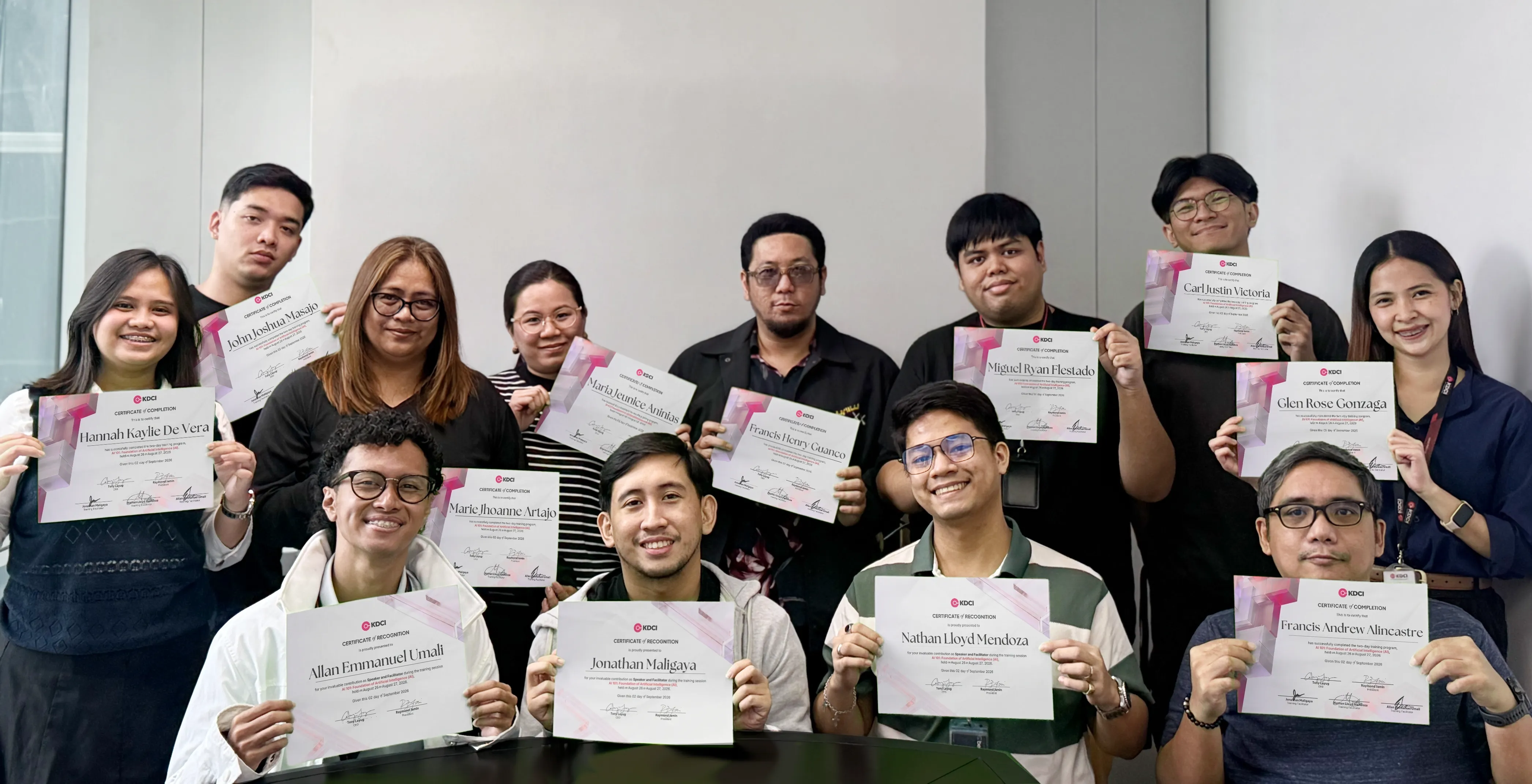
On August 26th and 27th, selected members from the Human Resources, IT/Support, Marketing, and Operations departments were gathered for the pilot session of AI 101: Foundations of Artificial Intelligence, a two-day professional development program designed to establish foundational AI literacy across the company.
This initiative represents a deliberate step within KDCI's broader AI adoption strategy, founded on the principle that AI competency should not be confined to technical departments alone. Rather, the company has articulated a vision in which every employee, irrespective of function or role, is equipped and encouraged to use AI as a means of enhancing operational efficiency.
The training was structured across two days, progressing from conceptual grounding to applied, hands-on competency.
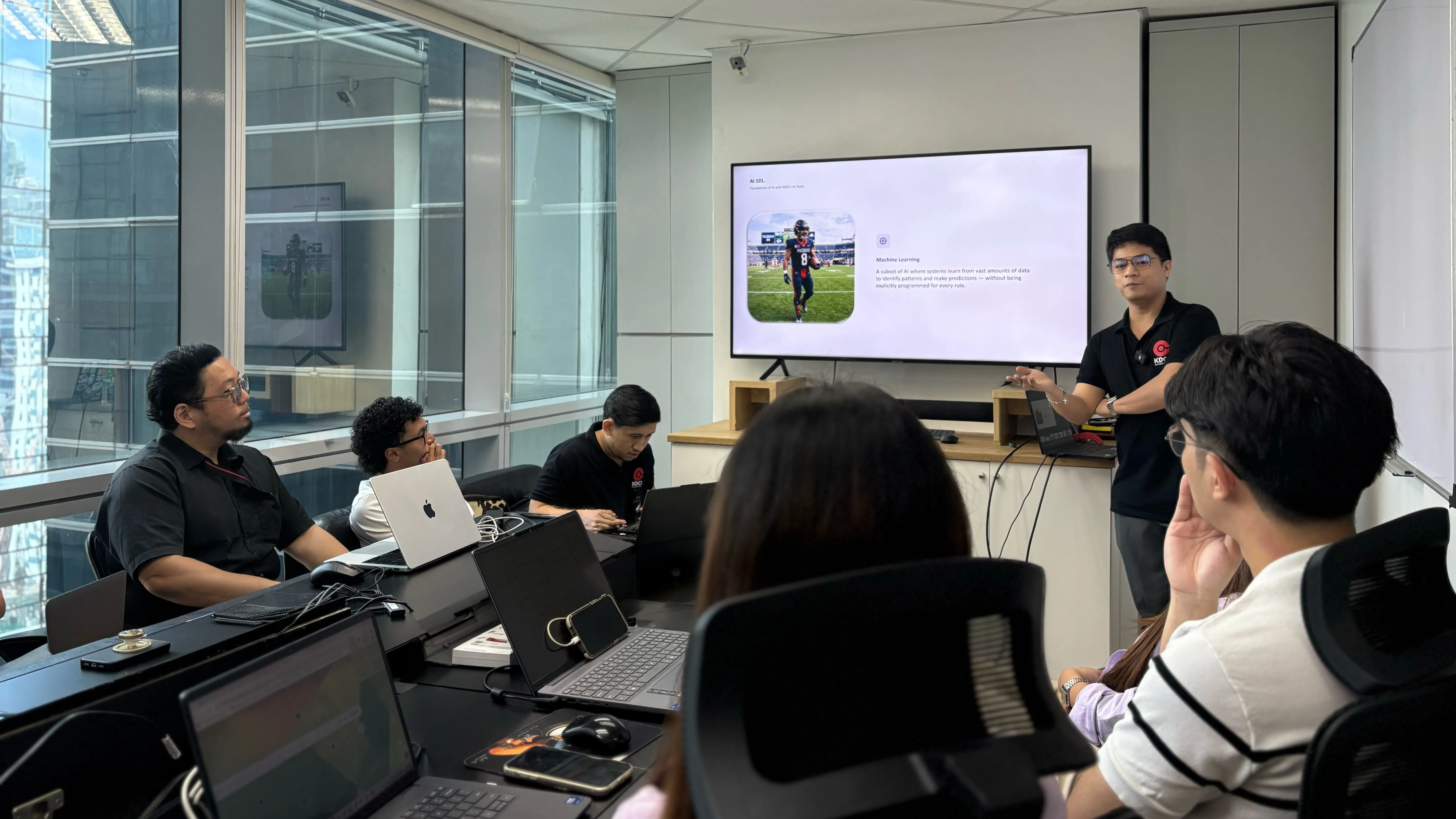
Day One - August 26, 2026 addressed foundational concepts, beginning with a clarification of what constitutes artificial intelligence beyond its common usage as an industry buzzword. This was followed by a comparative overview of prevailing large language models — namely ChatGPT, Claude, Gemini, and Copilot — and a discussion of their respective distinguishing characteristics. The session then progressed to "Prompting 101," an introductory module covering:
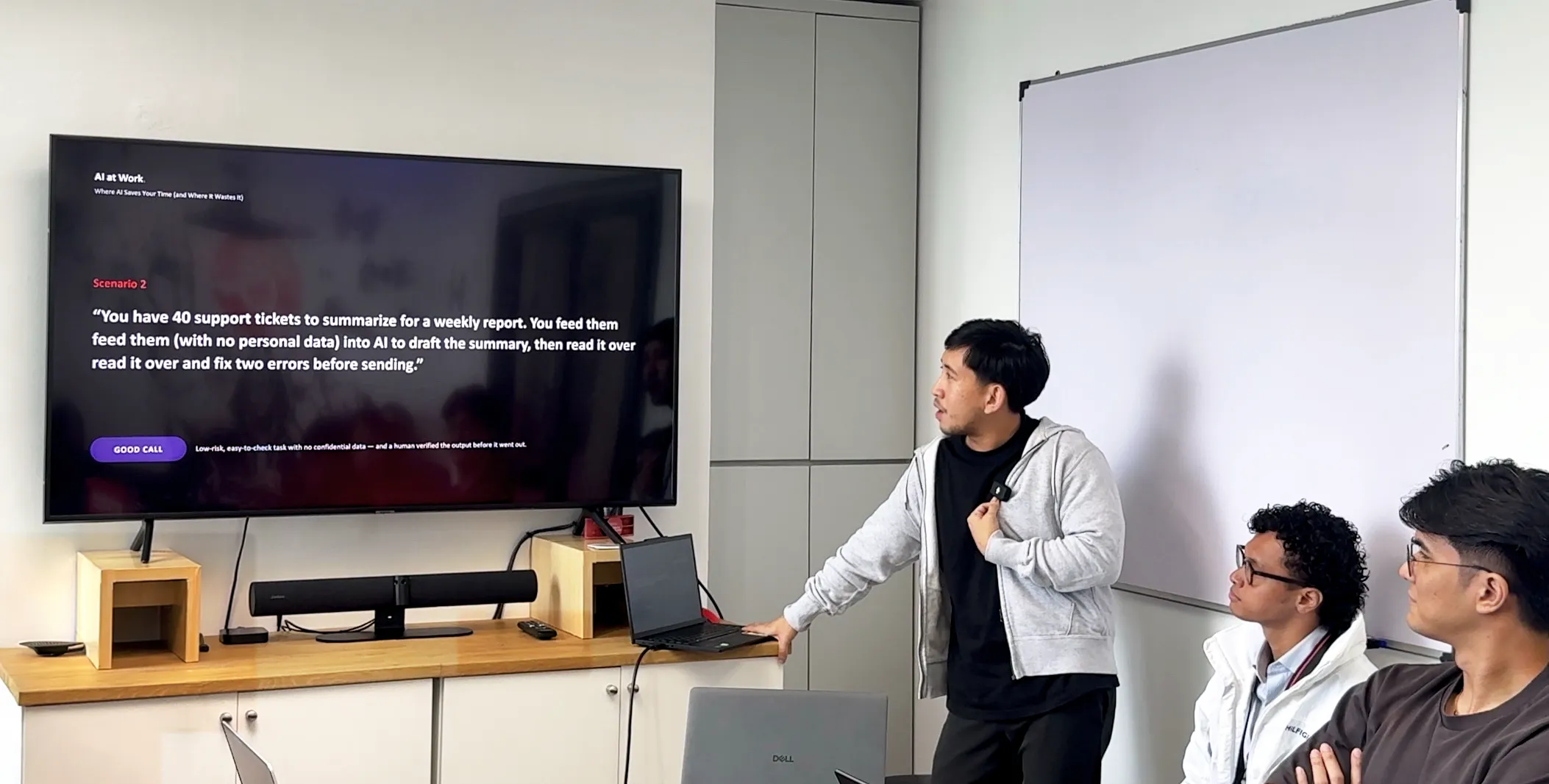
Day Two - August 27, 2026 was oriented toward the responsible and judicious application of artificial intelligence within a professional context. Topics addressed included:
The program was delivered through a discussion-based format, supplemented by interactive Kahoot! quizzes intended to reinforce key concepts and sustain participant engagement. Two experiential learning activities were incorporated to translate theoretical understanding into practical skill: an exercise in image recreation through iterative prompting, and a guided activity in the construction of an AI agent.
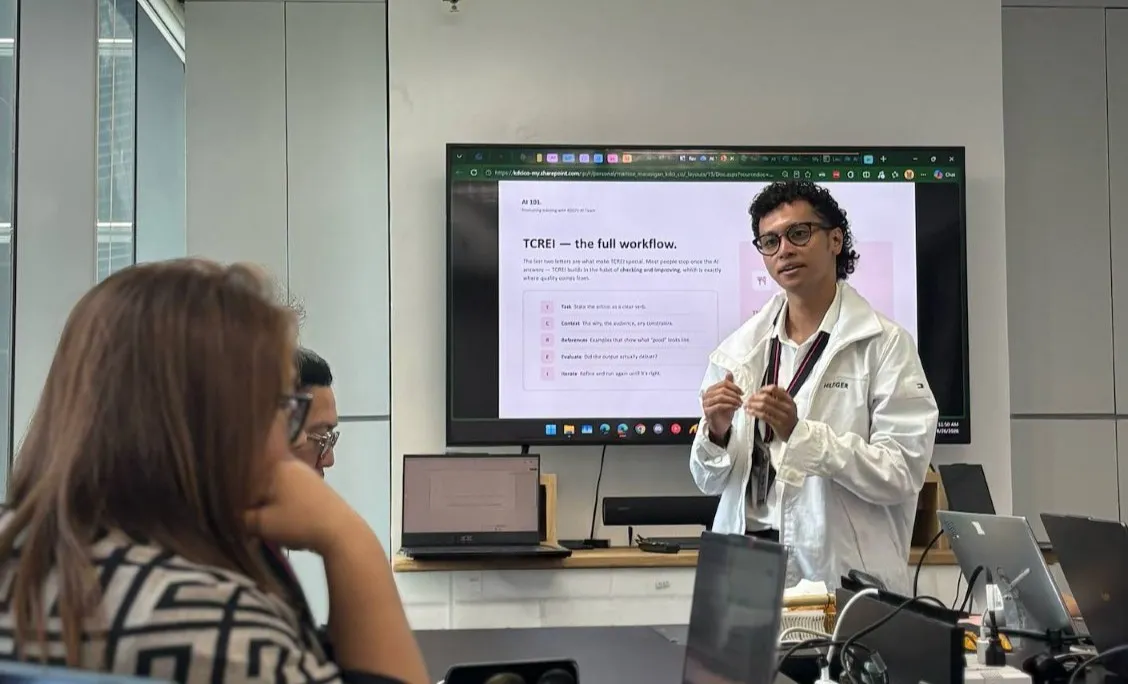
A particularly resonant moment in the program occurred during the session on responsible AI use, when facilitators posed the following question to participants for consideration:
"Would you like it if your AI Overview answers were formulated from opinions rather than real and factual data?"
This question served as a catalyst for substantive discussion regarding the manner in which AI-generated outputs may reflect underlying biases embedded within training data, underscoring the importance of critical evaluation when incorporating AI tools into professional workflows.
The AI 101 program should be understood not as an isolated training event, but as a component of a sustained, organization-wide commitment to artificial intelligence adoption. By establishing a shared baseline of AI literacy across departments, the organization aims to position artificial intelligence as an accessible and integral efficiency tool for the broader workforce, rather than a capability limited to specialized technical teams.
In light of the positive engagement and participation demonstrated during this inaugural session, a second offering of AI 101 is to be expected, with the intention of extending this foundational training to additional departments and personnel.
The organization extends its appreciation to all participants from Human Resources, Information Technology, Marketing, and Operations for their engagement and contributions, which were instrumental to the success of this first cohort.

Most AI pilots that never reach production die for the same reason: nobody owns the end-to-end design decisions connecting data science, infrastructure, and business requirements. Each piece gets built by a different team, in isolation, and nothing ties them into something that survives contact with real users. An AI solutions architect exists to close that gap — but before you read further, it's worth being honest about something most pages selling this role won't tell you: many organizations don't need this seat yet, and this page will help you figure out whether you're one of them.
An AI solutions architect designs the end-to-end blueprint for how AI gets built, deployed, and scaled inside an organization — sitting at the intersection of engineering, data science, product, and business leadership. This is different from a data scientist, who owns model performance, and different from a cloud engineer, who owns infrastructure reliability: the architect owns how all the pieces connect, and how a proof-of-concept actually becomes a maintainable production system rather than a demo that never ships. It's also distinct from the hands-on model-building work of hiring machine learning engineers or hiring generative AI engineers — the architect designs the system those engineers build inside.
One disambiguation worth stating plainly: this page is about staffing this role inside your own team, not engaging an outside AI consultancy. "Solutions architect" reads as a consulting-engagement title in a lot of the market, and KDCI doesn't sell consulting engagements. If what you actually want is strategic advisory work rather than a dedicated hire, our guide to AI consulting services covers that territory instead.
The role translates business requirements into architecture blueprints — data flows, model-serving strategy, integration points between systems that were never designed to talk to each other. A large part of the job is making tradeoff calls that nobody else is positioned to make: build versus buy, and the cost-versus-latency-versus-accuracy tradeoffs that shape whether a system is actually usable in production. The architect also presents these technical decisions to executive and non-technical audiences — translating "why this approach" into language a budget owner can act on.
Increasingly, the role also means building in governance from day one: access controls, model explainability, bias monitoring, and regulatory compliance, rather than retrofitting them after a system is already live. Where that governance work shades into actively defending the system against adversarial threats, that's a distinct specialization — see our breakdown of AI security engineer hiring, including the LLM Security Architect tier that sits closest to this role.
This is the honest question most companies should ask before hiring for this seat, and the answer for many is "not yet." A dedicated AI solutions architect earns its cost once one or more of these is true:
Below that threshold, a strong senior engineer or a fractional/contract architect often covers the same ground perfectly well. If you're mapping this role against the rest of your AI hiring plan, our AI team structure guide places the Solutions Architect as one of the two Scaler-level seats — the one that keeps multiple teams from building ten different silos instead of one coherent system — and our guide on how to build an AI team covers the process of staffing the rest of that structure.
Screen for a proven track record translating business requirements into production AI architecture — not just prototypes that demoed well and never shipped. Look for fluency across the data science, infrastructure, and product boundary, since the job is largely about connecting those three worlds rather than being the deepest expert in any single one. Experience with AI-specific risk — bias, hallucination failure modes, compliance gaps — matters as much as technical depth. And this is one of the few roles in this cluster where communication and translation skill is genuinely as load-bearing as technical ability: the person needs to brief both engineers and executives on the same decision, in language each audience actually understands.
A candidate who can only operate in one register — deeply technical with engineers, but unable to hold an equivalent conversation with a non-technical budget owner — will struggle with the actual job, regardless of how strong their architecture instincts are.
Published salary figures for this role vary unusually widely, and it's worth knowing why before you compare quotes: job-posting-based data and self-reported compensation data skew very differently at the senior end, since self-reported figures tend to include total comp (bonus, equity) while posting-based data usually reflects base salary alone. Robert Half's job-posting data puts the range at $142,750–$196,750; a broader compensation-data source puts base salary at $128,000–$185,000, with total compensation for senior and principal-level architects reaching $250,000–$340,000 once bonus and equity are included. That gap between job-posting figures and self-reported total comp isn't a discrepancy to resolve — it's a reason to ask any candidate or source what, specifically, a quoted number includes before comparing it to another.
Time to fill runs longer here than most technical roles in this cluster, and that's worth stating honestly rather than glossing over: general technical searches average around 48–89 days, but senior and principal-level technical searches specifically often run 60–120 days industry-wide. KDCI places pre-vetted candidates for this role in 7–14 days, at a flat monthly rate roughly a third below a comparable US hire — a real contrast, not an inflated one, given how genuinely hard this seat is to source. The same pre-vetted approach applies across our complete guide to AI developer hiring, for any other seat on your list.
By the Numbers
Every candidate is assessed on end-to-end architecture judgment, cross-functional communication ability, and production-readiness screening — whether a design actually survives contact with real infrastructure and real governance requirements, not just whether it looks right on a whiteboard.
You bring the scope, KDCI matches pre-vetted candidates against it, and your pick onboards within 7–14 days — against a US benchmark where senior and principal-level technical searches commonly run 60–120 days.
This is a genuinely hard seat to source, and the pitch here is speed and vetting, not an invented specialization claim: dedicated, pre-vetted talent screened specifically for the architecture judgment and cross-functional communication this role requires, at a flat monthly rate roughly a third below a comparable US hire.
Start Your Architect Search Tell us where your AI program actually stands, and KDCI will match you with pre-vetted architect candidates ready to start in 7–14 days. Speak with an outsourcing specialist to get started.
No — this page is about staffing the role inside your team on an ongoing basis. An AI consultant is an outside advisory engagement, typically project-based. See our guide to AI consulting services if that's what you're actually looking for.
Usually not yet. The signals worth watching for are multiple parallel AI initiatives, real governance or compliance exposure, or a senior engineer already doing this work informally and hitting capacity limits. Below that threshold, a strong senior engineer or a fractional architect typically covers the same ground.
The architect owns end-to-end design and the tradeoffs between systems; the engineer builds and maintains the systems within that design. One coordinates the blueprint, the other executes against it.
KDCI staffs this role at a flat monthly rate roughly a third less than a comparable US hire.
7–14 days — a real contrast against a US benchmark where senior and principal-level technical searches commonly run 60–120 days.

"AI automation specialist" is suddenly everywhere in job postings — enterprises are automating workflows with AI faster than most companies have managed to define the role cleanly. Two questions come up constantly: what does this title actually cover, and how is it different from an "AI automation engineer" listed right next to it on the same job board? This page answers both, so you don't have to piece it together from ten different listings that all define it slightly differently.
An AI automation specialist designs, builds, and maintains AI-powered automation across business workflows — connecting AI models, usually via API, to the operational systems a business already runs on, rather than building the models themselves. The work sits downstream of the model: taking something like an LLM's ability to read and reason, and wiring it into an actual process someone in the business depends on.
The distinction from traditional RPA (robotic process automation) is worth stating plainly: RPA handles fixed, repetitive rules against structured inputs. AI automation adds judgment and reasoning on top of that — handling unstructured inputs, making contextual decisions, and adapting when the input doesn't match the expected pattern exactly.
One boundary worth drawing early: this role connects existing AI models to business workflows — it doesn't build or train the models themselves. That's hiring machine learning engineers or hiring generative AI engineers territory, depending on whether the model is trained from your own data or built on a foundation model.
The day-to-day work is genuinely cross-functional. It starts with mapping existing workflows across departments — ops, support, sales, finance — to find where an AI-powered automation would actually save meaningful time, not just where automation is technically possible.
From there, the specialist connects LLM APIs (OpenAI, Anthropic, and others) to handle the judgment-heavy steps a fixed rule can't cover, typically building on orchestration or no-code platforms like n8n, Make, Zapier, or Power Automate, supplemented with custom code where the platform hits a wall.
The job doesn't end at launch: automations that fail need to fail gracefully — retrying intelligently and alerting a human — rather than failing silently and letting a broken process run unnoticed for weeks.
Here's the honest answer: the market hasn't settled this. Some employers use the two titles interchangeably, and plenty of job postings blur the line between them. Rather than pretending there's a clean industry standard, the more useful axis is breadth versus depth.
The Specialist tends to work across departments, leans on no-code and low-code platforms plus glue code, and front-loads business impact — the automation is visible and useful within days of being built. The Engineer tends to sit deeper in the stack: production ML systems, MLOps, cloud infrastructure, and the kind of longer-horizon technical debt that comes with owning infrastructure rather than a single workflow.
The pay data reflects this split more than it reflects any consistent scope difference: ZipRecruiter puts the average AI Automation Specialist salary at $76,465, while Glassdoor puts the average AI and Automation Engineer at $142,663 — for work that, on many job descriptions, overlaps almost entirely. The title itself is worth tens of thousands of dollars on paper, which says more about how inconsistently the market labels this work than it does about any real difference in the two roles.
If your need is narrower and code-heavy — production systems, deeper infrastructure ownership — our guide to hiring automation engineers covers that role specifically. If you'd rather hand off a single, bounded automation project entirely rather than staff a hire, our breakdown of AI development services covers when that route fits better. If what you just read matches the broader, cross-functional hire you actually need, keep reading.
Screen for fluency with at least one orchestration or no-code platform — n8n, Make, Zapier, or Power Automate are the most common. Beyond that, look for working comfort with LLM APIs and basic prompt orchestration, and enough Python or SQL to glue systems together when the no-code platform can't do it alone.
The differentiator from a purely no-code hire is an eye for failure modes: can this person design an automation that fails gracefully and alerts a human, rather than one that quietly breaks. The trifecta employers actually screen for is engineering mindset, business-process fluency, and AI-specific expertise — not any one of the three alone.
Pay varies enormously by how the role is scoped, not just by title. Broader industry data puts the wider band at $100,000–$180,000+ once LLM integration depth and business-process scope are factored in, above ZipRecruiter's narrower average cited earlier. Demand is real and growing: intelligent automation hiring is running at roughly 194 new US postings a week, with a flat-to-gently-rising trend through 2026. And the search itself takes time — specialized AI hiring in the US regularly stretches toward 90 days for technical AI/ML-adjacent roles, against KDCI's 7–14 days per seat, at a flat monthly rate roughly a third below a comparable US hire. The same pre-vetted approach applies across our complete guide to AI developer hiring, if this is one of several AI roles on your list.
By the Numbers
This role most often sits in the Integrator layer of a broader AI team — the seat that connects AI capability to a real business process rather than building the model underneath it. If you're scoping a full team rather than a single hire, our AI team structure guide maps this role alongside the other nine that make up a complete structure, and our guide on how to build an AI team covers the process of staffing it end to end.
Every candidate is assessed on workflow design judgment, fluency with orchestration and API tooling, and failure-handling discipline — whether an automation is built to fail gracefully or just built to work on the happy path. That's the internal skills assessment confirming deployment readiness before anyone reaches you.
You bring the workflows you need automated, KDCI matches pre-vetted candidates against them, and your pick onboards within 7–14 days — against a US technical-hiring benchmark that regularly runs into the months for this kind of specialized, cross-functional role.
Speed and vetting are the pitch, not an invented specialization claim: dedicated, pre-vetted talent who've been screened against the actual failure-handling and cross-functional judgment this role requires, at a flat monthly rate roughly a third below a comparable US hire.
See Your Shortlist This Week Tell us which workflows need automating, and KDCI will match you with pre-vetted AI automation talent ready to start in 7–14 days. Speak with an outsourcing specialist to get started.
Not necessarily — the market uses the titles inconsistently, but the useful distinction is breadth versus depth. Specialists work cross-functionally with no-code/low-code tools; Engineers sit deeper in production systems and infrastructure. See the comparison table above for the full breakdown.
Not deep software engineering, but some. The role leans on no-code and low-code platforms plus glue scripting — enough Python or SQL to connect systems the no-code tools can't handle alone.
RPA handles fixed, repetitive rules against structured inputs. AI automation adds reasoning — handling unstructured inputs and making contextual decisions RPA can't.
KDCI staffs this role at a flat monthly rate roughly a third less than a comparable US hire.
7–14 days, against a US technical-hiring benchmark that regularly runs into the months for specialized AI roles.


What started out as a few agents, has grown into an invaluable partnership with KDCI. With more than 40 team members, we are lucky enough to count as part of our Cedar Family. Thank you so much KDCI for making our Company better!

We have found KDCI to be a consistently reliable partner, always willing to ‘go the extra mile’ to ensure our valued customers receive the best possible service.

KDCI plays a very important role in our catalog and content operations. They are responsive, kind, and always willing to help us as much as possible. We have been working together for more than 4 years, and we hope our partnership will be even more fruitful in the future.

Having collaborated with KDCI.co for our creative needs, I can confidently attest to their unparalleled expertise and dedication. Their team consistently delivered innovative solutions that not only met, but often exceeded our expectations. Their professionalism and attention to detail are commendable.

KDCI were able to grow with us with any future requirements. We have a lot to do when it comes to our business, and everytime we come back, they're right there with us and able to deliver.

KDCI's team has been instrumental in helping us not only modernize our platforms but also increase the experiences for the customer, and to deliver on the tsunami of content that came their way.

We had a lot of difficulty finding qualified talent in the United States. Honestly, I don't think we had thought about outsourcing at all as a potential option, but we were very open to it once we heard about it. We love our KDCI team. They're just like a regular part of our team, it's just that they're thousands of miles away.

It's been five years since we started working with KDCI, and it just keeps getting better and better. We've grown together and achieved a lot of shared success. Overall, they're incredibly professional yet fun to work with. We are incredibly happy to have found them.

We're so glad we partnered with KDCI to develop a unique platform that delivers personalized customer experiences without compromising functionality or security. It was an amazing experience, I won't hesitate to start another project with them again.