Thank you! Your submission has been received!
Oops! Something went wrong while submitting the form.
Thank you! Your submission has been received!
Oops! Something went wrong while submitting the form.


.png)
For many businesses and local accounting firms, outsourcing is not just a backup plan, but a strategic venture that provides access to powerful technologies and a wide pool of specialized, cost-effective finance and accounting expertise.
Previously, we’ve done a round-up of the best Philippine general ledger accounting firms, top accounts payable providers, financial management firms, and accounts receivable companies. If you’re now on the lookout for a reliable financial specialist, this round-up contains the best financial specialist outsourcing firms in the Philippines. Speaking of specialists, you can also hire high-performing credit controllers from the best credit control agencies in the Philippines.
Finance and accounting is one of the most commonly outsourced departments by US-based clients, driven by the complexity of regulations, scarcity of accountants, high cost of hiring American employees, and the need for technological innovation.
A financial specialist works with companies or individuals and performs tasks involving financial support like budget preparation and management, financial analysis, financial advisory and consulting, and market research.
While most financial specialists have a bachelor’s degree in accounting, finance, or a related field, some may have a Master of Business Administration (MBA) — a one- to two-year post-graduate degree program. Financial specialists are also proficient in QuickBooks or any finance software program.
A strong grasp of accounting and finance concepts, as well as the ability to organize and present financial data, provide customer service, and thrive in a team environment are some of the most sought-after traits in a financial specialist.
The list below includes not only the best financial outsourcing companies, but also outsourced providers that offer complementary finance and accounting services — such as bookkeeping, payroll processing, management reporting, and taxation.
KDCI Outsourcing, or KDCI, is a leading BPO company nestled in Pasig City, Metro Manila. Since 2011, the firm has provided US-based businesses with comprehensive, tailored offshore staffing solutions with the overarching goal of bolstering operational efficiency, minimizing overhead, and empowering internal teams with high-caliber external expertise.
Throughout its partnerships with brands, KDCI has successfully onboarded outsourced professionals, including graphic designers, customer support agents, content writers, accountants, and financial specialists. The company’s financial specialists, in particular, offer a caliber rivaling in-house talent, delivering precise financial analysis, accurate forecasts, comprehensive financial reporting, and well-managed budgets at cost-effective rates.
Their commitment to integrity ensures that all financial data is processed carefully and aligned with relevant laws and compliance standards — with KDCI’s data encryption protocols adding another layer of security for your peace of mind.
KDCI’s financial specialists also excel in using AI and automation technologies to streamline their day-to-day financial tasks for faster turnaround times. Their proficiency and knowledge of FreshBooks, Microsoft Excel, ZohoBooks, and other leading finance software tools make them an integral asset to your outsourced financial services team.
The beauty of collaborating with KDCI is that you can hire other outsourced accounting and finance roles, such as an accountant or finance manager, to complement your financial specialists. This ensures you have a complete offshore team that can handle most financial operations with ease.
As one of the top Philippine finance BPO companies for US businesses, KDCI is a great provider of end-to-end offshore financial services that drive not only cost savings but also innovation, compliance, and long-term collaboration.
MicroSourcing is an outsourcing company established by Philip Kooijman in 2006. Since its founding, MicroSourcing has grown from a humble 13-man firm to a massive company with thousands of employees in dedicated offshore teams that collaborate with hundreds of clients across various industries.
It provides a wide range of outsourced job roles for accounting and finance departments, including accountants, bookkeepers, accounts receivable and payable specialists, and financial specialists.
MicroSourcing has junior, intermediate, and senior financial specialists — who are all proficient in Finbox, Microsoft Excel, QuickBooks, and other finance tools. Those at the junior level have limited experience as a financial specialist, with only 12 to 24 months of professional experience under their belt.
Their job responsibilities are simpler; they get in touch with debtors in case of overdue payments and read up on laws and regulations related to debt collection. Senior financial specialists also supervise juniors when creating customers’ payment plans. Juniors may use pre-approved guidelines for this task, too.
Intermediate financial specialists can handle more complex job responsibilities, bringing over four years of professional experience to the table. They provide financial advisory services, take charge of projects from start to finish, and execute company-aligned strategies.
While senior financial specialists have similar job responsibilities to their mid-level counterparts, they boast over four years of work experience in their role, making them more suitable for high-level decision-making or project implementation.
Based on your business needs, budget, and preferences, MicroSourcing can help you build a scalable team of financial specialists with varying (or similar) levels of seniority in around six weeks.
With the company’s success-driven approach to outsourced financial services, MicroSourcing stands out as a reliable financial outsourcing company for US businesses seeking highly specialized, cost-effective offshore support for their finance department.
Headquartered in Toronto, Canada and Makati, Philippines, Accubooks is a BPO company with a global client base and a suite of finance and accounting outsourcing services. These services include financial analysis, financial reporting, payroll, bookkeeping, accounts payable and receivable, management reporting, and many more.
Powered by an offshore team of senior certified public accountants (CPA), you can expect to work with high-performing professionals who are passionate about delivering stellar financial outsourcing services. Guided by Accubooks’ core value of integrity, every financial task — from creating financial reports to reconciling general ledger accounts — is performed in full compliance with US and international accounting standards.
Plus, the warmth and hospitality of Filipino CPAs make outsourcing less of an intimidating and transactional venture and more of a warm, supportive partnership between your internal and outsourced accounting and finance team. By working with Accubooks, you can enjoy a paperless environment where your financial data is digitally and physically safe from unauthorized disclosure.
Accubooks stands out as a solid pick for businesses seeking the expertise of veteran accounting and finance professionals.
D&V Philippines is a company specializing in tailored finance and accounting outsourcing, backed by decades of experience and veteran CPAs from established Philippine educational institutions. It provides outsourced CFO (Chief Financial Officer) and professional outsourcing services.
Aimed at CFOs with overwhelmed accounting departments, D&V Philippines’ CFO services provide additional offshore support in bookkeeping, management reporting, taxation, compliance, financial analysis, and the like.
Alternatively, its professional outsourcing services are targeted at clients with financial auditing agencies and accounting firms, as well as practices that offer financial advisory and financial management services. D&V Philippines’ outsourced professionals supplement practices with specialized talent, offloading non-critical tasks from in-house teams and improving performance, compliance, and operational efficiency.
Furthermore, the company has offshore staff who excel in some of the following finance software programs and enterprise resource planning (ERP) systems:
Whether you’re a CFO or an owner of an accounting firm, D&V Philippines is an excellent choice for an outsourcing partner due to its highly educated, tech-savvy workforce and personalized outsourcing solutions.
Emapta is a B Corp-certified outsourcing company that builds dedicated offshore teams with the premise of integrating them into their clients' internal teams. Thanks to its decades-long experience in the outsourcing industry, Emapta has developed a deep understanding of its clients’ needs, providing them with tailored offshore outsourcing solutions that align with long-term business goals.
The firm offers outsourced finance and accounting roles for auditors, loan processors, payroll officers, tax accountants, financial analysts, and many more. These professionals undergo a strict hiring process to ensure you get world-class talent that aligns with your company’s values and culture.
Requests for custom finance roles are available, too, so you can form your ideal outsourced financial services team. Unlike local hiring, Emapta can source and onboard Filipino offshore finance professionals into your team within a month, saving you time and money. With only a 2.4% voluntary attrition rate, the firm’s offshore finance teams promise stability, helping you maintain consistent service quality for the long haul.
Overall, Emapta is a solid choice for clients who value the long-term consistency and excellent service quality that comes with high employee retention.
Connext Global Solutions, also known as Connext, is a BPO solutions firm operating in Colombia, India, Mexico, and the Philippines. As a customer-centric service provider, Connext delivers world-class outsourcing services designed to meet the complex needs and goals of its clients. The company excels in outsourced customer service, back-office support, IT, healthcare, marketing, and financial services.
From bookkeeping to records monitoring, all of Connext’s financial services are built to support your business scaling efforts. If scaling your business is on the horizon, this outsourcing provider will leverage its knowledge of the finance industry as well as advanced AI technologies to source qualified finance expertise that further augments your offshore team’s performance during busy accounting periods.
Thanks to its round-the-clock IT team, robust IT facilities, and non-offshore data storage practices, Connext ensures that sensitive financial data is protected from data breaches, malware, and other online threats.
All in all, Connext’s scalable outsourcing services and commitment to data privacy make this company a trustworthy BPO partner for businesses of all sizes.
Featured in KDCI’s round-up of the best cost accounting companies in the Philippines, Outsourced is a premium BPO company known for its ISO 9001 and ISO 27001 certifications — a reflection of its dedication to surpassing client expectations and standards as well as ensuring data security. Thanks to its rigorous, AI-driven hiring process, only the top 1% of candidates are chosen by Outsourced’s expert recruitment team
It offers full-time offshore accountants, bookkeepers, commercial analysts, compliance officers, financial analysts, and many more. With a retention rate above 98%, you’ll be working with high-caliber finance professionals who are as fiercely committed to Outsourced as they are to your business. These individuals have also mastered most, if not all, major accounting and finance software, such as FreshBooks, Xero, and Zoho.
They’re proficient with AI tools, too. For example, Outsourced’s financial analysts use Microsoft Power BI to simplify the generation of financial reports, whereas its bookkeepers streamline the process of organizing transactions with the help of QuickBooks. Their mastery of such tools helps them meet tight deadlines, avoid costly mistakes, and remain compliant with accounting standards.
As an elite BPO company that lives up to its premium services, Outsourced is recommended for high-octane businesses that prefer working with talented outsourced accounting and finance professionals.
Booth & Partners is an outsourcing firm founded in 2013 that powers businesses with first-rate offshore solutions, promising cost savings, flexibility, security, and operational efficiency. It hires, analytics, design, digital marketing, bilingual customer services, IT, and finance and accounting.
The company’s offshore Filipino bookkeepers, payroll specialists, and accounts receivable and payable specialists are highly experienced in their respective roles. Apart from the day-to-day tasks associated with their role, these accounting professionals are also equipped with critical thinking and analytical skills needed for performing growth-driven analyses to help businesses achieve financial stability.
Overall, Booth & Partners is a reliable outsourcing provider for clients looking to augment their internal accounting team with exceptional talent from the Philippines.
Financial specialists are a must in every finance and accounting department. Because local specialists have higher paychecks, outsourcing this role becomes a cost-effective solution.
At KDCI Outsourcing, we have financial specialists who can make sense of even the most complex financial data to help you make wise, data-driven decisions that yield stability and measurable results. We also offer end-to-end outsourced finance and accounting solutions to close skill gaps, so your internal team can focus on their core competencies.
Experience world-class finance and accounting outsourcing support with KDCI. Contact us and schedule an appointment with our outsourcing experts today!

.jpg)
As the world’s BPO and call center capital, the Philippines is an attractive destination for finance and accounting services. This article explains the popularity of outsourced accounting and finance solutions and includes a list of the top 11 roles you can outsource to the Philippines.
The Philippines is the top choice in outsourcing finance and accounting due to the following reasons: its cost-effectiveness, excellent communication, and excellent track record for providing excellent finance and accounting outsourcing services.
Did you know that there are over 200,000 certified accountants in the Philippines? Not including the finance professionals, the total number of professionals in the industry is huge. This has led to a lot of multinationals outsourcing their finance and accounting functions, such as bookkeeping, accounts receivable, and accounts payable, to the Philippines.
The average hourly rate of an accountant in the United States in 2024 is $39.27 USD, while it only costs $6.12 USD in the Philippines. Meanwhile, the average hourly cost of hiring a financial analyst in the United States is $40.92 USD per hour, whereas the same professional in the Philippines costs around $7.58 USD an hour.
By opting for Filipino professionals, companies can save on expenses and pool more resources on high-value initiatives.
Another reason outsourcing finance and accounting to the Philippines works so well is because of how easy it is to communicate with Filipinos. This is not surprising, as most Filipinos are fluent in English and familiar with Western culture, minimizing linguistic and cultural barriers during the partnership.
Finally, the biggest reason companies are turning to the Philippines for outsourced accounting and finance services has to do with its reputation as a top outsourcing provider. Following in the footsteps of multinational companies like Accenture, IBM, and Deloitte, more and more overseas businesses are open to outsourcing finance and accounting to Philippine BPO companies.
Ready to outsource your finance and accounting roles and functions, but not quite sure where to start? Below are the most common finance and outsourcing services in the Philippines!
This involves the systematic recording of a company's financial transactions, including sales, purchases, receipts, and payments. It ensures that financial records are accurate and up-to-date, and businesses outsource it primarily to reduce costs, increase accuracy, and free up resources.
The reason that Filipino bookkeepers are popular is because of their attention to detail and proficiency in various accounting software, including QuickBooks, Xero, ZohoBooks, and more.
This encompasses the overall management of a company’s financial information, including maintaining the general ledger, preparing trial balances, and ensuring compliance with accounting standards.
As this is directly responsible for maintaining a business’s financial integrity and compliance, many choose to outsource this accounting function to skilled offshore Filipino accountants to ensure high-quality services at a lower cost.
This involves managing outgoing payments, including invoice processing, payment approvals, and vendor management. The goal is to ensure that all payments are made accurately and on time.
By outsourcing this finance function to an accounts payable outsourcing provider, companies can improve their efficiency and accuracy as well as reduce the risk of errors and fraud. Filipino professionals excel in managing high volumes of transactions and adhering to deadlines, making them a top choice.
This is about managing incoming payments, including invoicing customers, tracking payments, and managing collections. Accounts receivable is a time-sensitive accounting task, and to ensure the timely collection of revenue, many choose to outsource this to accounts receivable service providers to reduce the burden on internal staff.
Since the Philippines offers skilled professionals who are adept at managing receivables and improving collection rates, they’re usually hired for this accounting function.
This involves calculating employee wages, withholding taxes, and ensuring compliance with labor laws. Payroll processing includes generating paychecks and managing benefits.
As there’s plenty of room for error, most businesses outsource to Filipino payroll specialists who are proficient in handling complex payroll processes and financial regulations to ensure compliance, reduce errors, and streamline payroll operations.
This involves preparing financial statements, including balance sheets, income statements, and cash flow statements, to provide a comprehensive view of a company’s financial health.
To ensure accuracy and compliance with regulatory standards, companies outsource financial reporting to Filipino accountants who are skilled in preparing detailed and timely financial reports, helping businesses make informed decisions.
This provides strategic financial management, including financial planning, risk management, and advisory services on financial decisions. This process often includes part-time or interim CFO support, so businesses outsource CFO services to access high-level financial expertise without the cost of a full-time executive.
The Philippines offers experienced finance professionals who can provide valuable strategic insights, making them a popular option.
This involves preparing and filing tax returns, ensuring adherence to tax laws, and planning tax strategies to optimize liabilities. With complex tax regulations and the risk of penalties, many companies outsource tax services to Filipino tax professionals from top tax accounting companies, who are knowledgeable about local and international tax laws, providing reliable tax solutions to ensure compliance.
These include conducting internal and external audits, risk assessments, and compliance checks to ensure the accuracy and integrity of financial statements.
As a finance function that requires objectivity, companies outsource this task to a third-party accounting outsourcing service provider for independent and objective evaluation of financial statements, enhancing credibility and transparency. With a pool of qualified auditors and reputable financial auditing agencies, the Philippines comes as a top choice for high-quality assurance services.
This involves evaluating creditworthiness, managing credit risk, handling collections, and maintaining credit reports for effective management of credit-related activities.
Outsourcing credit management improves cash flow, reduces bad debts, and enhances risk management, especially when working with Filipino professionals who are skilled in credit analysis and collections, providing reliable credit management solutions.
These involve analyzing financial data, forecasting future financial performance, and developing strategies to achieve financial goals and improve strategic decision-making. Companies like to outsource this finance function to financial management firms in the Philippines to gain expert insights and get detailed financial models.
If you know what accounting and finance functions you want to outsource to the Philippines, the next step is choosing the right outsourcing service provider to work with to ensure the best results.
We’ve listed the top 10 Philippines outsourcing companies known for providing high-quality finance and accounting outsourcing services.
KDCI Outsourcing is a leading BPO company in the Philippines, offering custom finance and accounting outsourcing services to global brands. They specialize in building offshore finance and accounting teams in the Philippines that fit well with your organization for seamless collaboration.
Their top outsourced financial services include general accounting, accounts payable, accounts receivable, payroll, taxation, and more. Majority of their clientele are SMEs from the USA, Australia, and Europe. With their varied services and great fit, we recommend them for companies that prioritize collaboration above all else.
D&V Philippines is a finance and accounting outsourcing company that provides a wide range of services, including bookkeeping, payroll, and CFO support. Their services are tailored to support CFOs in making better financial decisions and professional service firms through staff augmentation.
Their clientele consists mostly of large corporations and enterprises, hence they’re a great choice for CFOs of large companies and professional firms looking for additional hands either temporarily or permanently.
Connext Global is an outsourcing company that offers outsourcing solutions, including finance and accounting services. They specialize in offshore accounting, helping clients build dedicated offshore teams in the Philippines. Their services cover anything from managing financial records and bookkeeping to tax preparation and compliance.
Most of their clients are small to medium-sized businesses across different sectors, making Connext Global an excellent service provider for those looking for support but still want to be a bit hands-on in building their offshore accounting teams.
TOA Global is an outsourcing company that specializes in providing dedicated accounting professionals to support accounting firms and financial planners. Their services are designed for speed, quick adoption, and scalability.
While TOA Global’s primary market is Australian businesses, it also provides outsourced services to companies in New Zealand and the USA. They’re a great choice for clients looking for a quick fix — either because they need to augment their staff or scale their financial operations immediately.
Beepo is a BPO company that offers outsourced finance and accounting services, such as accounts receivable, accounts payable, and bookkeeping. They mainly work with startups and SMEs, especially those looking for cost-effective solutions in Australia and beyond.
With a strong focus on cost-effectiveness, Beepo is the best choice for brands whose primary reason for outsourcing is to reduce expenses.
Platinum Outsourcing is an outsourcing company that offers bookkeeping, payroll support, accounts payable, and accounts receivable services. They primarily cater to Australian businesses, using the International Financial Reporting Standards (IFRS) as their standard for financial reporting, aligning well with Philippine and Australian accounting standards.
Because of this, we recommend Platinum Outsourcing for Australian companies looking for finance and accounting services that ensure accounting compliance.
Personiv is an outsourcing company that provides custom finance and accounting services, with a focus on scalability, efficiency, and cost reduction to help companies do more with less and sharpen their competitive edge. This makes Personiv a great choice for companies that prioritize efficiency and want to do a lot with a lean team.
Yempo Solutions is an outsourcing company that specializes in finance and accounting services and provides clients with instant price quotes. Targeted at companies in Australia, the USA, and other parts of the globe, Yempo Solutions aims to improve efficiency and cut costs, making them an excellent partner for those looking to get more done with fewer resources.
Triple i Consulting is an outsourcing company offering accounting solutions spanning from bookkeeping to tax consulting and advisory, with heavy emphasis on compliance and efficiency.
Their target audience includes SMEs and professional firms seeking reliable finance and accounting solutions, making Triple i Consulting a great choice for those looking for comprehensive finance and accounting services.
AHC Certified Public Accountants offers outsourcing services that primarily revolve around accounting and financial reporting. They primarily target SMEs and individual clients seeking professional outsourced solutions to maintain compliance and improve efficiency. As such, AHC Certified Public Accountants can be a great service provider for companies with smaller team headcounts.
If you are from the US see Top 10 Accounting & Finance Outsourcing Companies for Boston, Massachusetts Businesses.
There are plenty of reasons why brands prefer finance and accounting outsourcing services in the Philippines. Be it cost reduction, access to highly capable accountants, or scalability – Philippine finance and accounting outsourcing companies have got you covered!
KDCI Outsourcing is a specialized BPO company that builds outsourced finance and accounting teams in the Philippines. Their specialists not only excel in their craft, but they also mesh well with your company culture. This way, they can collaborate seamlessly with your in-house teams, bridging the gap between culture, time, and geography, so your offshore team feels in-house.
Augment your internal headcount with high-performing offshore support from the Philippines. Send us an inquiry and let’s discuss how we can up your finance and accounting game.
From payroll processing to updating product information, data entry is an inevitable task in any business. While data entry is a non-core administrative function, it still plays a critical role in our day-to-day operations. Data entry establishes a database of information that can be used for data analytics and decision-making.
However, data entry is often taken for granted. If businesses are not careful, data can be a destructive force to reckon with — a missing zero or an outdated customer information can spiral into inaccurate reporting and hefty penalties!
If your company is swamped with data and you have a small in-house data entry team, processing and organizing all that information can be a herculean task. Not to mention that increasing your team’s headcount through local hiring may not be the most financially sustainable move.
In this case, it’s a sign to outsource data entry services to a Philippine-based BPO company like KDCI Outsourcing. In this article, we’ll show why an offshore data entry team is vital for optimizing labor costs and ensuring data accuracy.
Data entry is not an easy job. Below are the three most common challenges in data encoding:
You may have the fastest and most accurate data entry professional in your team, but that doesn’t mean they’re immune to typos — especially if data entry is done manually due to a lack of advanced data entry tools. Manual data entry increases the risk of human error, which can spell financial trouble for your business.
The job responsibilities of a data entry professional not only involve encoding data, but also cross-checking and verifying information. When done manually, data encoding can take a significant amount of time to complete. If your in-house data entry team is overwhelmed with unprocessed data, catching up with pending data entry work can be challenging.
Doing data entry work for hours across five business days can be physically and mentally draining. Consequently, this can lead to a loss of focus and poorer performance, affecting overall productivity.
Across industries, data entry work is unavoidable. Many companies have dedicated in-house data entry to organize, verify, input, and update data in a database management system. However, the ability to maintain an in-house team long-term raises questions regarding overhead and operational efficiency.
The sections below weigh the pros and cons of maintaining an in-house data entry team.
An in-house data entry team works in the same time zone and location as their employer, creating a seamless cycle of collaboration, knowledge-sharing, communication, and feedback between data encoders and managers.
Because local employees understand the cultural and linguistic nuances of their home country, there are little to no barriers to communication, which strengthens teamwork and avoids misunderstandings.
Local data entry teams have first-hand exposure to institutional knowledge and norms. This equips staff with the internal know-how of their company’s workplace culture and processes. Thanks to their familiarity with their country’s local data compliance standards, all data sets are accurate and compliant.
Proximity and time zone advantage allow for better oversight of your in-house data entry team. The ability to set quality standards, implement feedback mechanisms, and oversee daily workflow ensures that your in-house data encoders can perform well and produce the required data entry work.
While there is beauty in face-to-face collaboration, the cost to maintain an in-house data entry team can strain your budget. From employee benefits to annual subscriptions, the costs add up over time. As a consequence, you have fewer resources for strategic or high-impact business initiatives.
Employee turnover — whether voluntary or involuntary — can cost you half or twice a data encoder’s salary. The more data entry clerks quit, the more data your team will process, resulting in delays, poor productivity, and increased turnover.
In-house data entry teams are harder to scale. In the US, the average annual salary of a data entry specialist is $42,098 USD per year. If your company has a slew of data to encode, adjusting your staffing needs by hiring locally can be the most exorbitant move you’ll ever make.
Not only do you need to invest more in recruitment and onboarding, but you also need to pay for additional equipment and software subscriptions. Furthermore, the time and resources spent on training new hires can potentially affect data accuracy and team productivity.
In some cases, companies lack the proper technology to streamline data tasks. Perhaps they’re still relying on outdated software or engaging in tedious manual data entry. Technology upgrades are expensive, and training your internal data entry team to use new tools costs time and money.
This may result in errors and inefficiencies as your in-house data entry professionals are still acclimating to the newly introduced tool.
KDCI Outsourcing is a data entry BPO company that offers tailored offshore staffing solutions to clients around the globe. Having worked with brands such as Apple and Amazon, the firm has garnered a wealth of experience providing outsourced services, including data entry and data processing.
That being said, this data entry outsourcing company can power up your data entry processes with advanced technologies and scalable support. Here’s what KDCI Outsourcing offers to overwhelmed companies:
Offshore outsourcing is the cheapest outsourcing model. You save on company expenses, as wages and cost of living are lower in developing countries.
According to Jobstreet, a Filipino data entry specialist earns an average of $582 USD to $758 USD a month — that’s $6,984 USD to $9,096 USD per year! Since the Philippines has a cheaper cost of labor, you can hire several data entry specialists for the price of a single US-based data entry specialist ($42,098 USD a year).
Like other BPO companies, the cost of equipment, software subscriptions, recruitment, training, and turnover is paid for by KDCI Outsourcing — effectively slashing your operational costs by a whopping 70%! By leveraging data entry outsourcing for business, your company will have greater financial confidence to invest in strategic business ventures.
KDCI Outsourcing takes data accuracy seriously. With the sharp eye of KDCI’s data entry specialists, they can accurately input and cross-check customer or financial data from any data source, such as receipts and reports.
Their mastery of Microsoft Excel, Tableau, and Power BI enables them to organize and visualize data for further analysis. Combined with their fast typing speeds, the company’s offshore data entry team can ensure speed and accuracy in every data entry task.
Due to the repetitive nature of data entry, KDCI’s offshore data entry team optimizes data encoding and processing by leveraging AI and automation tools that extract scanned text, identify data patterns, and detect data inaccuracies. These tools minimize human error, improve operational efficiency, and simplify data organization, review, and correction.
Overall, when you outsource data entry services to KDCI Outsourcing, you get the privilege to work with detail-oriented professionals who embrace AI and automation in any data entry project.
Counting on your in-house data entry team to handle large data volumes is not healthy or feasible. To keep up with the increase in workload, your team will put in more hours, making them susceptible to burnout. For any company, burned-out employees mark the beginning of turnover. Unless you scale your business operations, your data entry professionals will leave for better opportunities.
KDCI’s offshore data entry outsourcing services are scalable. With the cost-effectiveness of Filipino talent, you can support your internal data entry team with additional headcount within 25 days (or less), accelerating data encoding and processing to make the workload more manageable for your data encoders. In case of fewer data entry tasks post-busy seasons, you can freely downsize your offshore data entry team.
With KDCI Outsourcing, you can scale your team as needed and maintain a high level of operational efficiency without worrying about labor costs.
Some companies may shy away from offshore outsourcing due to time zone differences. But believe it or not, this can be a huge advantage. Outsourcing companies operate all year round, 24/7. Whether it’s the Fourth of July or Christmas, KDCI Outsourcing can provide the needed support to keep your business running even if you’re internal team is out on holiday.
KDCI Outsourcing has outsourced data entry specialist teams that work round-the-clock — including graveyard shifts — so all your data entry needs are met during your team’s working hours and downtimes. Because there’s an alignment in working hours, communicating with your outsourced data entry team is much more seamless.
Businesses have complex needs and goals that require nuanced, flexible, and long-term solutions. That’s why KDCI Outsourcing and other BPO companies don’t subscribe to the one-size-fits-all approach to outsourcing.
KDCI Outsourcing has a team of outsourcing experts who can deliver a carefully crafted outsourcing solution based on your needs, goals, and workplace culture.
With KDCI’s tailored offshore outsourcing solutions, your company can adapt to changes in data entry processes and industry needs, drive measurable results in your internal data entry team, and foster alignment in goals and expectations.
Aside from data entry specialists, KDCI Outsourcing offers other outsourced data encoding and processing roles:
Whether you need help with product data entry or data cleansing, KDCI’s diverse roster of offshore data entry professionals can get any data entry work done.
Many outsourcing companies, including KDCI Outsourcing, follow strict hiring processes. They work with the client to define qualifications and requirements for outsourced professionals. Most clients, for example, prefer candidates with some experience in data encoding and who are computer-literate, proactive, detail-oriented, and cooperative.
To meet a client’s standards and expectations, KDCIs HR Outsourcing reviews candidates’ resumes and vets them through an assessment test and a series of interviews. These tests and interviews predict a candidate’s potential performance, behavior, and compatibility with the client.
However, depending on a client’s preference, they may assist KDCI’s recruitment team in assessing potential candidates, so all onboarded data entry professionals meet the highest standards. By hiring top candidates, the client can count on their offshore data entry outsourcing team to accomplish data entry projects with accuracy and compliance in mind.
Data entry professionals work with sensitive information, including customer and financial data. For many companies planning to outsource data entry services, data security and privacy are at the top of their concerns. In industries where customer, financial, and health data are processed, a single data breach is enough to lose customer trust and tarnish a firm’s reputation.
At KDCI Outsourcing, data privacy and security are a priority. It demonstrates its commitment to data privacy by deploying robust encryption solutions as a protective measure against breaches and theft. As part of KDCI’s onboarding process, a non-disclosure agreement is signed by each outsourced data entry specialist so they can uphold data confidentiality and anonymity while working with you.
With a round-the-clock team of IT professionals performing regular security audits, rest assured that all your data is in safe hands.
Today, data is accessible with a click of a button. But with information coming in left and right, companies with small or no dedicated internal data entry teams risk falling behind in data entry work and productivity.
By outsourcing data entry tasks to KDCI, you can build a full offshore team of data encoding and processing professionals who can skillfully and efficiently process, input, and organize all data to free up your in-house team and maintain smooth operations throughout.
Ready to optimize your data entry processes? Get in touch with KDCI Outsourcing today, so you can experience the unmatched accuracy of our data entry specialists first-hand!
.png)
We often think of CEOs as superheroes, carrying the weight of their organizations on their shoulders. Their jobs extend beyond making decisions and collaborating with stakeholders; CEOs have an inherent responsibility to stay updated on everything that’s happening around the world — from volatile market conditions to turbulent current events.
As the head of the company, they don’t panic — rather, they act swiftly and make informed decisions that guide the business to growth. Despite having so much on their plate, CEOs take the time to recalibrate their priorities. This article discusses the top leadership priorities in the US, namely agility, talent, and trusted partners.
Agility demonstrates how well a business adapts and thrives in a dynamic, ever-evolving market. Agile companies are prepared for sudden market changes, reflected in their resilient business strategies that ensure both success and customer satisfaction.
One must not treat agility as a run-of-the-mill buzzword, but as a framework that helps all levels of the organization — from the CEO to employees — to stay ahead of the curve.
The following sections tackle the benefits of agility and provide tips for CEOs to prioritize a more agile business model.
In a world of rising customer expectations and fast-paced industry changes, agility has become a crucial indicator of an organization’s adaptability. Here are the advantages of an agile business:
Because customers are the drivers of success, agile businesses remain cognizant of their evolving needs and preferences, translating their feedback into tailored products and experiences that reflect their current expectations.
Speed to market, or time to market, refers to how fast a company can ideate a product and deliver the finished product to customers. Agile leaders don’t sit around; they take action and prioritize speed to market as faster development cycles create opportunities for greater market share and relevance in a volatile market.
Agile businesses always prepare for the unexpected. An upcoming health crisis? An agile organization may already have business continuity measures in place to help employees shift to remote work. By remaining agile — despite looming crises and emerging industry trends — businesses can stay futureproof and adapt to changes without disruptions.
Agility instills the importance of a growth mindset. Agile leaders and employees are open to change. They innovate processes, strategies, and products as needed due to market shifts. Through innovation, businesses can become more competitive and promote a culture of creativity, responsiveness, and resilience.
Agility entails investing in emotional intelligence. Emotional intelligence equips leaders and staff with the ability to engage in quick, rational decision-making processes and handle feelings of discomfort.
It also helps everyone resolve conflicts diplomatically, take constructive criticism, work with people of different personalities, and resolve frustrations when things don’t go well accordingly.
Prioritizing agility comes with structural change. While change doesn’t come overnight, there are three ways you can bring agility to the forefront of your organization:
One big mistake CEOs must avoid is creating a rigid, set-in-stone plan or strategy. Agility is about being uncomfortable with change and uncertainty. This doesn’t mean scrapping everything altogether. As a CEO, make it a habit to tweak your plans and strategies based on current best practices and market trends.
By staying informed about trends and current events, you can think two steps ahead and anticipate possible changes, reassuring everyone that your organization can navigate whatever challenges come its way.
To embrace agility is to embrace a love for a growth mindset and continuous learning. Challenges are perceived as opportunities, mistakes and failures are treated as avenues for learning, and skills can be further honed through effort and dedication. An agile workplace teaches employees resilience despite setbacks and imperfections. But a culture of growth and learning begins with you — the CEO.
One example is Satya Nadella, Microsoft’s CEO. Previously, the tech giant had a “know-it-all” culture that focused on rigidity and cultural resistance, including the gatekeeping of knowledge. Under Nadella’s leadership, Microsoft started embracing a “learn-it-all” culture — a culture that promotes collaboration, shared learning, and experimentation.
Thanks to this shift, the company has risk-takers who are open to learning from failure, which has borne fruit in new technologies: GitHub Copilot, an AI-powered coding assistant, and Azure AI, a cloud service suite. If it weren’t for this cultural shift, Microsoft would still be behind other industry giants in AI and cloud computing technology.
Microsoft’s transformation showcases that learning and innovating don’t stop just because you’re a well-known name in the industry. As a CEO, you have to be a learner, too. Request feedback from staff, catch up and share insights on industry trends, and join employees at workshops and seminars. All these show how invested you are in intellectual growth.
By modeling intellectual growth, your employees will follow suit and become as invested as you in expanding existing knowledge.
Knowledge should not be kept in silos. Strengthening teamwork lies in sharing information between teams and departments. In Microsoft’s case, Azure AI and GitHub Copilot were made possible thanks to the close collaboration of its departments. By working with other teams, your employees get exposed to diverse perspectives and new tools, which helps identify blind spots in problem-solving. In turn, this coalescence of ideas sparks innovation.
To foster cross-team collaboration, get everyone on board first. Create shared objectives and align them with company goals. A dedicated group chat is also great for virtual correspondence between members. Whether it’s work, feedback, or watercooler banter, a virtual channel encourages open communication between departments.
All members should be oriented on their roles and expectations, as well as the functions of each department in your company. This helps them take responsibility for all their tasks and understand the complexities of a department.
Encourage everyone to try out unorthodox ways of doing things and share their outcomes with others, which helps promote knowledge sharing. Finally, by making everyone feel valued for their ideas and contributions, you build a culture of mutual respect between you, your employees, and their colleagues.
While implementing these measures is easier said than done, the time and resources you put into cross-functional collaboration transform your organization from a stagnant business with uncooperative teams into a flourishing, agile company with strong camaraderie.
Talent drives organizational success. Because talent is the face of a company, it should be treated as an investment. With labor shortages along with the rising expectations and standards of candidates, talent issues are no longer the sole responsibility of HR leaders.
Now, CEOs and HR departments are treating talent as a strategic priority to access specialized skills, gain a competitive advantage, and harness innovation. If investing in your people has never been a priority, the next sections will convince you to think otherwise.
CEOs and senior leaders who invest in talent position their organizations for success. Here’s why you should do the same:
Integrated Benefits Institute (IBI), cited by Achievers, found that most employers report difficulties in drawing (73%) and retaining (61%) their talent. How well an organization can acquire and retain talent can make the difference between optimizing and pooling more resources on recruitment.
CEOs and HR leaders must not neglect employee engagement and performance. The more employees are engaged, the better they perform. This improves retention rates and motivates staff to come to work, incentivizing top performers to stay and saving the company hundreds of dollars on turnover, onboarding, and training.
The quality of employees determines a company’s quality of customer service. When organizations fail to keep tenured, high-performing employees or settle for mediocre hires, they can’t expect to maintain a high quality of customer service. Consequently, poor customer service leads to dissatisfaction and loss of revenue.
Talent investment doesn’t stop at hiring the right candidate. In fact, nurturing new and existing employees can bolster productivity and drive growth for your organization. Here are two ways to invest in talent:
Just because a candidate has all the skills, qualifications, and experience to do the job doesn’t mean they’re the right fit. By assessing culture fit, you can determine whether a candidate’s behavior, personality, communication style, and values align with your organization’s culture.
Culturally fit employees are more engaged, collaborative, and productive, which helps build a positive office culture and professional relationships between their colleagues and senior leaders.
To evaluate a candidate’s culture fit, ask behavioral questions that probe into how they resolve conflicts or overcome challenges. Questions related to work environments and their preferred level of autonomy are great, too. By asking the right questions, you can filter out ill-fitted candidates and avoid unnecessary turnover.
Whether it’s a new hire or a seasoned employee, talent development and empowerment go a long way in maintaining performance and retention. According to Deloitte, CEOs are empowering talent through the following ways:
While flexibility and recognition are important, they’re only half of the story. As a CEO, you must also challenge your employees and renew their sense of purpose at work. To develop and empower your people, provide mentorship opportunities where senior leaders train and nurture employees’ people management and leadership skills.
Leadership development equips employees with the grit to handle responsibilities that come with leadership roles. It also prepares the organization for the next generation of managers and executives who can lead teams with confidence and empathy. By encouraging employees to lead smaller teams or projects, they gain a first-hand experience in navigating team dynamics, addressing conflict, and delegating tasks.
Apart from leadership development, you can also spearhead cross-training sessions or hold workshops to empower employees to move out of their comfort zones. However, it’s important to remember that employee development and empowerment involve active participation from leaders at all levels of the organization.
Outsourcing has evolved into a strategic asset. Businesses treat it as an avenue to bridge talent gaps, expand their market, innovate systems, and scale departments without the slowdown of overhead expenses.
Cost-cutting remains an appeal, though. However, forward-thinking CEOs and senior executives understand that outsourcing companies are not just vendors, but an extension of an organization.
The next two sections tackle the advantages of working with outsourcing companies and include a brief tutorial on finding the right outsourcing partner.
Although outsourcing is not for every company, we can’t deny the advantages it brings. Here are three reasons why CEOs must outsource to a service provider:
Unsurprisingly, companies are leveraging outsourcing as a talent strategy. According to data by SHRM, US hiring costs amount to an average of $4,683 USD per employee. By outsourcing to the Philippines, or a developing country, you can drastically cut 70% of labor costs, leaving you with more resources to fund R&D initiatives and other high-impact investments.
Scaling teams with outsourcing partners is easier. For example, if you need to ramp up graphic design production, you can hire Philippine graphic designers for an average of $403 USD to $579 USD, depending on the designer’s experience.
With faster time-to-hire and lower cost of Filipino graphic designers (or any outsourced role), outsourcing puts you at an advantage where doubling team headcounts and scaling a business becomes financially viable without ballooning overhead.
Outsourcing has become a driver of market share expansion. When companies outsource to service providers, they get acquainted with the local market, monitoring trends and patterns. From there, organizations can appeal to the said market, which helps improve their brand visibility.
Partnering with the right outsourcing company brings strategic value that surpasses cost savings. Here’s how to begin your search:
A successful leader weighs the pros and cons of outsourcing. Hence, as a CEO, you’re expected to have well-defined goals and a clear rationale for outsourcing. Is it to modernize outdated infrastructure and systems? Do you need more specialized talent?
Either way, objectively evaluating your workforce and daily operations helps you decide if outsourcing is the right strategy to complement your team and meet business needs.
Cheap doesn’t mean best. When evaluating potential outsourcing partners, do a comprehensive background check of your shortlisted service providers. The best BPO companies boast the following:
There are outsourcing firms that specialize in a particular function. For instance, if you’re outsourcing accounting and finance, consider working with the best accounting firms for optimal results.
Look for BPO companies with similar goals, values, mission, and vision as your organization. This ensures alignment, trust, and understanding between your company and the service provider.
There’s only so much a CEO can do by themselves. But with the help of a BPO provider like KDCI Outsourcing, we can ease the burden off your shoulders, so you can focus on what you do best: decision-making, management, and collaboration.
KDCI Outsourcing offers tailored offshore outsourcing solutions for various functions and industries, including human resources, real estate, property management, and many more. By helping you build your offshore team, you can scale your operations and maintain utmost flexibility even in the most turbulent of times.
Let’s help you become an agile, future-proof organization. Speak to our outsourcing experts today!
.jpg)
In the 21st century, business websites are no longer a luxury but a necessity to thrive in a competitive market environment. By not having a website, companies are missing out on a substantial number of potential customers in the market. Whether you’re planning on building your website or redesigning an old one, you probably have heard of site-builders like Joomla, Drupal, and WordPress.
With several CMS, or content management system, options available, it is important to research and find the best CMS platform that will fit your needs. WordPress is the right CMS for many businesses today, and with good reason.
Using WordPress may involve a learning curve, but it has many benefits, especially for long-term businesses and projects. Here are 10 reasons why WordPress is the best CMS for your business.
As an open-source content management system, anyone has the right to modify, redistribute, use, or study WordPress’s source code as they deem fit at no cost. This fosters a healthy community of passionate users who are dedicated to fine-tuning the platform’s features, releasing security updates, and creating plugins and themes.
The beauty of using WordPress is the diverse selection of themes and plugins available for your dream business website. While there are free themes and plugins, some of them operate on a freemium model, with basic features available for free and premium features locked behind a paywall.
What makes WordPress the best CMS platform is its high level of customization that simplifies web design.
When you install a WordPress theme, you can change its default colors and remove or rearrange elements according to your needs without writing code. You can also take your site’s functionality to the next level by installing a plugin designed for search engine optimization (SEO) and analytics.
Hence, with the right theme and plugins, you can create a professional, fully functional business or e-commerce website.
WordPress is available on desktops and smartphones. Whether you’re tweaking website content or switching up a theme color, the cross-platform nature of WordPress gives you the freedom to manage your WordPress site on the go, from commute to couch.
Want to add a full-screen slider, contact forms, or Instagram feed? WordPress can achieve that through plugins. It’s like having an app store where you can download and install third-party features for your website. If you want a plug-and-play website that will look and function precisely the way you need it to be, this website builder is the best choice.
Did you know that WordPress is by far the most popular CMS on the market? It’s so prevalent that it owns 61.4% of the market share. Because there is a vast number of developers and designers for the platform, you can always count on their help if you need support.
Another benefit of this is that most web developers and designers you would probably work with are already familiar with WordPress — you just need to find the right people to give you the results that you want.
After the development of your business website, WordPress is simple enough to master — even if you’re not the most tech-savvy person. By putting in some effort to learn the basics, you can easily manage your WordPress website by yourself.
WordPress also boasts a friendly and straightforward user interface that you can tinker with and make changes without being too overwhelming or confusing for the average WordPress user.
In addition, you will be able to write blog posts, upload images, manage content, and utilize a large number of file types for any content type. It’s fully functional without the need for any IT support to code for you. You just need to invest time to learn how to use it.
All websites and web applications are prone to hacking. WordPress, like its competitors, gets hacked too. However, since it has the majority of the market, there are companies and people who are dedicated to fixing vulnerabilities. Aside from that, the people behind WordPress itself are continually updating the platform — optimizing performance and preventing security breaches.

As your company grows, you naturally expect more users to visit your WordPress website. WordPress’ customization features — along with its flexibility to accommodate additional functions — make it an excellent choice for long-term projects.
If you have additional plugins or web services that you want to integrate into your website, WordPress can sync them right up. Since it is a widely used and highly popular platform, you can expect a slew of companies constantly developing and upgrading new web apps for you to utilize with the platform.
If you’re looking to step up your SEO initiatives, WordPress is the best CMS for you. Designed with SEO in mind, you can customize permalinks, write meta descriptions, craft alt texts for images, and integrate SEO plugins like Yoast SEO. With these features and SEO tools at your disposal, you’re setting up your WordPress site for success.
WordPress is the best CMS platform for your business. Flexible and adaptable, it is built to support a wide range of industries and niches. If you decide that WordPress is the right website builder for you, it may be a good choice to find an outsourced web development team that will develop a website for you.
At KDCI Outsourcing, we have a dedicated offshore team of WordPress experts who can develop, design, or overhaul your website from scratch — giving your business a brand-new visage that will entice and convert visitors into paying customers. They can also easily add layers of security and optimization tweaks that will safeguard your website and business from online threats.
If needed, we can also hire Filipino graphic designers and content writers to help you with design and blog production.
Ready to debut a WordPress website that’s truly unique to your brand? Reach out to KDCI Outsourcing, and let’s bring your dream WordPress website to life!
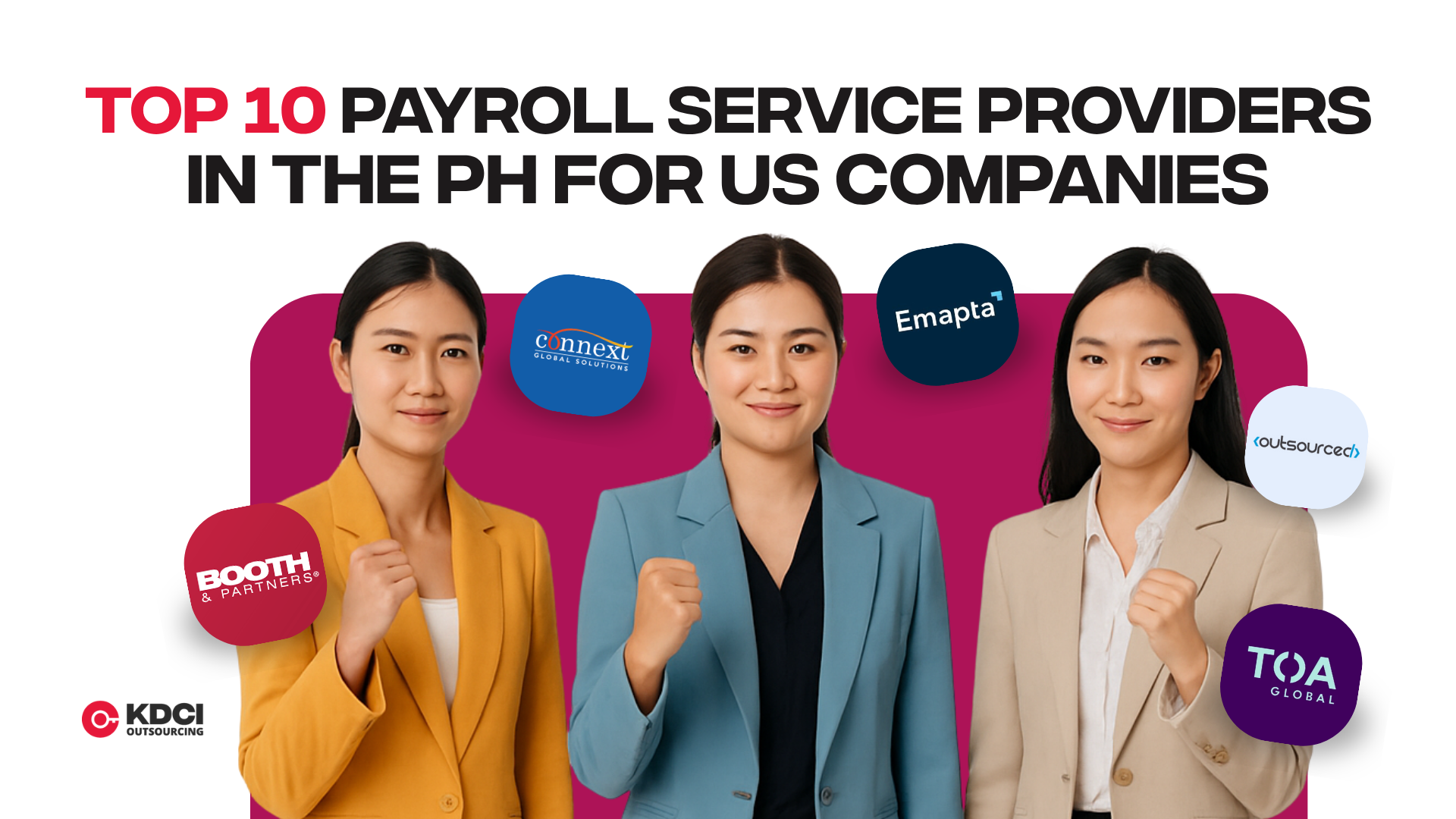
Managing payroll across borders brings more than just administrative work. US companies face challenges like payroll complexity, compliance risks, time-consuming payroll calculation, and potential payroll errors — all of which can impact employee satisfaction, financial stability, and operational efficiency. Partnering with a reputable Philippine payroll service provider helps streamline operations, enhance accuracy, and improve both employer-employee trust.
For US companies expanding operations in the Philippines, outsourcing payroll functions makes business sense. Not only does it help you stay compliant with local labor laws, but it also allows your internal teams to focus on core business activities instead of administrative tasks. This guide explores the best payroll service providers in the Philippines for US companies, offering solutions that combine expertise in payroll outsourcing, advanced payroll software, and local compliance knowledge to simplify your payroll operations.
Outsourcing payroll to the Philippines is a strategic decision for US companies looking to optimize processes while minimizing compliance risks. Here's why it's becoming an industry norm:
Philippine providers specialize in navigating the country's labor laws, tax codes, and government-mandated contributions (SSS, PhilHealth, Pag-IBIG). These services ensure your payroll process meets strict regulatory requirements, helping you avoid fines or legal complications.
With advanced payroll software and tools, providers minimize payroll errors and streamline repetitive tasks through automation and digital transformation trends. This leads to faster payroll cycles, fewer disputes, and enhanced accuracy.
In addition to processing salaries, most Philippine providers handle benefits administration and mandatory contributions, giving you peace of mind that all statutory obligations are met on time.
Top firms offer global payroll services, integrating your Philippine operations with your US headquarters’ systems, streamlining reporting, and aligning payroll data globally.
Timely and accurate pay has a direct impact on managing employee satisfaction and retention. By eliminating delays and inaccuracies, these providers help maintain a motivated and engaged offshore workforce.
When compared to maintaining an in-house payroll department, outsourcing reduces overheads while improving overall efficiency — allowing businesses to redirect resources to growth-driving activities.
Below is a curated list of some of the most reliable and trusted payroll outsourcing providers in the Philippines. Each offers unique strengths to fit different business needs.
KDCI Outsourcing leads the pack in payroll outsourcing, offering end-to-end accounting & finance outsourcing solutions supported by modern systems and experienced payroll specialists paired with great human resource services. KDCI’s services help US companies tackle common challenges like payroll complexity, compliance risks, and administrative overload with scalable services and automation.
Key Services:
KDCI ensures accurate, compliant, and timely payroll, enhancing operational efficiency and employee satisfaction. Their Accounting Services offer comprehensive financial management solutions, while their back office services strengthen HR and payroll functions for growing global companies.
TOA Global specializes in global payroll and HR outsourcing for accounting firms, offering precision-focused services that eliminate payroll errors and simplify compliance-heavy environments where accuracy and audits are paramount.
Key Services:
TOA Global’s expertise ensures financial reporting and payroll operations meet the highest compliance benchmarks — ideal for industries where accountability is critical.
Magellan Solutions delivers flexible and budget-friendly payroll solutions for SMEs looking to simplify their HR and payroll workflows. Their services address common SME challenges like managing benefits, avoiding payroll errors, and keeping up with compliance requirements.
Key Services:
Magellan’s offerings help small businesses achieve efficiency through automated payroll tools that simplify routine operations while maintaining accuracy.
Emapta integrates advanced technologies into their payroll operations, allowing seamless connections with your HRIS, ERP, and accounting systems. Their tech-first approach reduces manual input, cuts down processing times, and minimizes payroll errors.
Key Services:
For companies embracing automation and data-driven operations, Emapta is a strong choice to modernize your payroll process.
Connext Global Solutions helps companies manage remote Philippine teams with transparent, efficient payroll operations. They offer end-to-end solutions to ensure compliance, timeliness, and alignment with US business processes.
Key Services:
Their expertise ensures remote teams are managed efficiently, reducing payroll complexity and boosting employee satisfaction through reliable, on-time payments.
Booth & Partners delivers secure, compliance-driven payroll solutions built for businesses that prioritize data security. With ISO-certified processes and advanced encryption protocols, they protect sensitive employee data while ensuring accurate payroll delivery.
Key Services:
Their focus on security makes Booth & Partners ideal for financial, tech, and healthcare sectors where data protection is non-negotiable.
Digital Minds BPO offers affordable payroll solutions designed for cost-conscious businesses, from startups to scaling SMEs. Their services integrate seamlessly with other HR outsourcing functions for greater operational efficiency.
Key Services:
Their solutions enhance accuracy, reduce overhead, and improve cash flow management while supporting employee satisfaction through timely, accurate payments.
Visaya KPO is known for its client-centric approach to payroll services, offering flexible, tailored solutions designed to align with your business model and operational needs.
Key Services:
Visaya KPO is ideal for businesses seeking hands-on support and adaptable services for evolving payroll needs.
Stealth Agents specializes in providing dedicated, full-time payroll specialists to act as an extension of your US-based HR and finance teams. This model ensures consistency, accuracy, and clear communication.
Key Services:
Stealth Agents’ dedicated approach streamlines payroll processes while reducing risks of payroll errors through continuity and accountability.
Outsourced.ph delivers scalable payroll solutions for businesses of all sizes, from startups to enterprises. Their flexible offerings grow with your company, ensuring your payroll operations stay efficient and compliant at every stage.
Key Services:
Their adaptability helps businesses scale quickly without sacrificing operational control or accuracy.
When selecting a Philippine payroll service provider, here are key factors to evaluate:
Outsourcing payroll to the Philippines gives US companies the flexibility to focus on business growth while leaving complex, compliance-heavy payroll operations to trusted experts. Whether you're seeking automated payroll systems, scalable solutions, or specialized support, the providers listed here deliver reliable, secure, and efficient services designed to enhance employee satisfaction and minimize risk.
Ready to simplify your payroll operations in the Philippines? Contact KDCI Outsourcing today to learn how our tailored payroll solutions can help your business improve accuracy, ensure compliance, and boost employee satisfaction.
.png)
Employee turnover is a nightmare. Businesses are left in shambles as they look for a replacement to bridge operational gaps. Employees, meanwhile, shoulder the aftermath of a departed employee: Additional workload, productivity loss, and poor mental health. This is not all, though.
Companies are competing for talent — the cream of the crop. On top of rising labor costs, organizations are also creating attractive compensation packages and benefits that align with the standards of applicants. If you’re afraid of losing your top performers, you’re not alone.
There’s one good news: Employee retention can be addressed, albeit by working with a dedicated team from an outsourcing partner. Let’s tackle how well internal vs outsourced teams deal with retention and turnover.
Companies that manage to retain their employees in a given period demonstrate strong employee retention. As a business owner, you understand the importance of keeping your high-performing employees for much longer. Here’s why employee retention matters:
Engaged employees equal increased morale. When companies foster great camaraderie and healthy professional relationships among team members, employees will feel connected with their peers — resulting in a happy, productive workforce that looks forward to coming to work each day.
Employers who challenge employees to try out different roles — like a minor leadership position — or undertake new projects help build the grit and confidence to overcome the discomfort of moving out of one’s comfort zone. This leads to higher job satisfaction and a deeper sense of purpose in the workplace.
Much like forging a solid working relationship with peers, maintaining a strong relationship with customers is also vital for retention. From ensuring consistent brand voice to offering nuanced solutions, long-tenured employees know the complexities associated with high-quality customer experiences.
Newer employees, though, need to overcome a learning curve to match the caliber of more experienced employees. Hence, by retaining tenured staff members, companies can continue offering superb customer experiences, further improving customer perception and brand reputation.
Did you know that the cost of hiring a US employee is $4,683 USD? If we factor in the cost of equipment, benefits, and training for each employee, companies can expect to spend around thousands each year. By prioritizing retention, organizations can hire internal staff and fill jobs faster.
This is especially handy for mid-level, senior, or executive positions. Through internal hiring for higher positions, HR departments have more financial wiggle room for hiring and training entry-level candidates.
Whether an employee is fired or leaves voluntarily, employee turnover reflects your organization’s workplace culture and potential for career advancement. Here are the effects of high employee turnover:
Fewer employees translate to more workload. Staff members crunch the deliverables of departed employees while juggling their own tasks, which spirals into poor productivity, low morale, and, ultimately, missed deadlines.
On the client’s side, delays are a no-go, and this affects their perception of your business. On your employees’ side, they treat the increase in workload as a sign to leave for greener pastures. Higher retention is not just healthier for your tenured employees, but it also strengthens client-business relationships.
Finding a replacement can cost around half or even double the salary of an employee. High turnover entails investing more time and money in posting job advertisements as well as recruiting and training new employees.
When employees leave, companies have fewer options for internal hiring for senior positions, forcing them to recruit an external resource who has little institutional knowledge.
Employee reviews are like a “performance check” for companies. Former employees express their dissatisfaction through poor ratings, signaling to job seekers that the company does not treat its employees well. This makes your organization a less attractive workplace for potential candidates, which in turn translates to difficulties in hiring qualified talent.
Here, let’s explore how internal vs outsourced teams stack up in performance, loyalty, scalability, and collaboration in relation to employee retention and turnover.
Turnovers are an inevitable part of running a business. But if turnovers are a common occurrence in your company, that’s a point of concern. Employees quit for a multitude of reasons, including:
and coronary/ischemic heart disease (347,000). Overworked employees suffer from productivity loss and low morale, thus compromising the quality of their deliverables. To protect their physical and mental health, they quit.
Because employees know their worth, they want to work for a company that aligns with their values, hones their existing skill set, and offers a healthy work-life balance. As a result, the competition for attracting top talent becomes even tougher. If your employees often leave your company, you risk losing your high-performing employees to a competitor.
Outsourced teams are your helping hands, taking care of tasks that your company may not have the time and manpower to complete. They help enhance productivity, as outsourcing teams free up your internal staff from excess workload and non-core tasks. This allows your company to meet increased customer demand and expectations without sacrificing service quality and efficiency.
Furthermore, outsourcing providers can offer performance management tools as well as data-driven insights on employee performance, helping you identify low performers and create tailored professional development programs.
By leveraging these resources and improving opportunities for career development, you create loyal, purpose-driven employees who are confident of harnessing their potential for future promotions.
Therefore, outsourcing becomes not just a way to offload repetitive tasks, but also a means to maximize your internal team’s skill sets and performance for long-term growth and retention.
Loyalty is not dead. According to West Monroe, cited in an article by Nonprofit Resource Hub, most employees (82%) exhibit high employer loyalty. While employees work for a company for 3.8 years, as per the Bureau of Labor Statistics, they can always change their course for the better. A company with great offers? Employees are ready to leave (59%) and seize the opportunity for a new beginning — one that guarantees growth.
That’s why, for companies, retaining employees is a challenging task. This is due to:
However, every staff member who leaves brings with them the knowledge and skills they acquired to another organization. With potential candidates expecting more from their employers, companies must rethink how to attract and retain future employees.
If you’re struggling with improving retention rates, outsourcing work to an external provider can be of great help — and you don’t have to lay off your entire team while doing so.
For example — if your company has had a streak of ill-fitted hires lately — an outsourcing team from a recruitment process outsourcing (RPO) company can augment your hiring efforts with out-of-the-box strategies for sourcing better-fit candidates.
Not only is time-to-hire significantly reduced (40%), but you’ll also get the bonus of working with employees who align with your organization’s core values and fit into your company culture like a glove.
Combine culture fit with equal task distribution between your internal and outsourced teams, and you’ll have productive employees who are happy to stay and help your company grow.
Scalability is always on the horizon, especially if your business is experiencing rapid growth. It’s one thing to aspire for scalability, but to be fully prepared for it? That’s another story. From budgeting to hiring the right people, there’s a lot to think about. While there’s no “perfect” time for scaling a business, increased workload and high employee turnover are clear-cut signs that you need to scale your operations.
But with the high cost of labor in the United States and developed countries, hiring locally may not be the most financially viable solution. Although it’s important to scale purposefully, balancing budget, performance, and retention can be challenging for internal teams.
Picture this: Your internal customer service team is overwhelmed due to a surge in inquiries. It also doesn’t help that your organization has not invested in the right technology for optimizing customer support. With your agents overworked to the bone, their morale and quality of service plummet. High-performing agents leave, and sooner or later, some of the agents follow suit, leaving the rest to pick up the slack.
This situation doesn’t just happen in customer service or any department with high turnover. As mentioned previously, outsourcing to an external provider can help ease everyone’s workload. After all, outsourcing partners take pride in their scalable solutions. Need 10 to 20 outsourced professionals? Your outsourcing partner will take care of supplying the needed headcount.
Because labor is cheaper and recruitment costs are covered by an outsourced partner, it’s more financially viable to scale your team as needed according to demand. With more people on deck, work becomes lighter for your internal staff. Top-performing employees also stay and engage with company initiatives.
Overall, outsourcing encourages smart, purposeful, and cost-effective scaling. By scaling with a reliable outsourcing partner, your company has ample manpower to handle the workload while maintaining optimal service quality and productivity.
Collaboration is tighter among internal teams. Everyone works the same hours at the same workplace. Experienced employees boast institutional knowledge that comes with tenure. Companies with good internal collaboration have effective leadership practices and productive employees.
However, organizations that often dismiss employees’ ideas or feedback set themselves up for turnover due to a lack of respect and appreciation.
Outsourcing providers offer a hybrid outsourcing model for companies that value collaboration between internal and external teams. While this model brings cost savings and efficiency, the beauty of hybrid outsourcing also lies in the ability of both teams to leverage each other’s strengths.
Internal teams are also exposed to best practices and fresh perspectives, challenging outdated mindsets. This strengthens communication and combats isolation and burnout, making your in-house team feel more connected than ever before. When your employees feel they are a part of a group, they’re less likely to quit their jobs.
Employees come and go, but there might be a recurring pattern to their departure. Whether it’s because of toxic office politics or a lack of recognition, turnover has repercussions for your business.
At KDCI Outsourcing, we help companies boost their retention rates through our outsourced human resources solutions — designed for productivity, efficiency, and performance. Our expertise in HR and recruitment enables us to tackle the root cause of turnover and implement appropriate solutions for retaining employees.
Don’t wait until your employees leave in droves. Nip turnover in the bud and establish your team of offshore HR professionals. Speak with our outsourcing experts today, and let’s discuss how we can help.
.png)
In today’s fast-paced digital economy, customer experience (CX) isn’t just about resolving tickets—it’s about designing a journey where customer needs are anticipated, met, and exceeded at every touchpoint. As businesses grow, the challenge becomes clear: How do you deliver personalized, human-centered customer support at scale while managing costs and maintaining consistency?
That’s why many leaders ask: KDCI vs customer service platforms — which is the better solution for building scalable, human-centered CX?
If you’re managing multiple channels, struggling with slow response times, or watching customer satisfaction scores decline, it’s time to rethink how you structure your support. In this blog, we’ll compare traditional customer service platforms with KDCI — a leading outsourcing partner providing customer service outsourcing in the Philippines.
Customer service platforms like Zendesk, Freshdesk, and Salesforce help businesses organize communication workflows, automate ticketing, and gather essential customer data to improve support operations.
Platforms bring structure through automation, self-service knowledge bases, and omnichannel dashboards. They improve operational efficiency by streamlining processes and generating reports on KPIs.
But here’s the truth: platforms are tools, not solutions. They require skilled employees to manage them, and no technology can replace the empathy, adaptability, and relationship-building skills that drive customer loyalty and long-term brand loyalty. Platforms help process inquiries faster, but they can’t deliver the human connections your users expect.
If your customer journey relies on authentic, human-to-human interaction, platforms alone won’t meet your goals.
KDCI Outsourcing is a trusted outsourcing partner in the Philippines, providing dedicated offshore support teams to help U.S. businesses deliver exceptional customer experience at scale. From live chat and email support to voice services and social media moderation, KDCI helps brands grow while staying connected to their customers.
Here’s how KDCI compares to traditional platforms:
KDCI delivers more than just headcount. We build offshore teams who understand your customer needs, your brand voice, and your industry. Whether you need five agents or fifty, KDCI helps you scale customer support with empathy and expertise.
With real people handling your inquiries, you foster stronger connections that improve customer satisfaction, drive customer loyalty, and enhance brand loyalty.
Already using platforms like Zendesk or HubSpot? KDCI’s teams integrate seamlessly into your existing systems, ensuring alignment, transparency, and operational continuity. This lets you keep your tech stack while adding the human touch that modern customer experience demands.
For businesses also looking to enhance their ecommerce operations, KDCI offers specialized ecommerce support outsourcing to handle everything from order management to after-sales service.
Your website might run 24/7 — but does your customer support? KDCI’s teams operate in shifts that align with your business hours, ensuring your users receive timely, thoughtful service no matter when they reach out. Whether during product launches or peak seasons, we maintain operational efficiency without sacrificing quality.
KDCI offers more than just customer support. As a full-service outsourcing partner, we help optimize your business through a wide range of services:
If you’re looking to streamline marketing alongside customer support, our digital marketing outsourcing services are designed to drive traffic and engagement while keeping your messaging aligned across channels.
One vendor. One partner. Infinite possibilities.
KDCI leverages outsourced customer service solutions and AI tools to streamline operation, but we know that technology alone doesn’t create loyalty — people do. Our agents bring empathy, cultural awareness, and critical thinking to each interaction, strengthening connections and improving customer satisfaction.
This unique blend of technology and human insight delivers superior results, turning simple conversations into opportunities to strengthen customer loyalty and build lasting relationships.
At KDCI, we treat customer feedback as a vital tool for growth, not just a metric. Our agents capture valuable insights during daily interactions, providing you with actionable customer data that informs product development, marketing strategies, and service improvements.
Industry experts agree: listening to your customers is the most effective way to refine the customer journey and ensure future success.
A platform might suit your needs if:
KDCI is the right choice if:
For businesses seeking end-to-end operational support, our human resource support outsourcing provides scalable solutions for admin, finance, and more.
Delivering outstanding customer experience isn’t just about investing in the latest tools — it’s about building the right structure. While platforms improve processes, KDCI Outsourcing offers the people, strategy, and expertise to drive real connections, foster customer loyalty, and achieve sustainable growth.
With a focus on customer service outsourcing in the Philippines, KDCI helps U.S. businesses stay competitive by enhancing operational efficiency, driving brand loyalty, and maintaining a strong, customer-first reputation.
Whether optimizing your website’s support functions, improving your omnichannel engagement, or scaling with agility, KDCI delivers solutions rooted in human empathy and business strategy. Our teams, backed by industry experts in CX, ensure your business stays responsive, efficient, and aligned with modern expectations.
Contact KDCI today to build a support solution that elevates your brand, strengthens your relationships, and keeps your customers coming back.
If you'd like, I can now help optimize this for meta title, meta description, and SEO schema markup. Let me know!
.jpg)
As brands flood online spaces with curated, visually appealing images and snappy, digestible short-form content, social media has undoubtedly become one of the most essential channels for engagement, growth, and visibility. And there’s no denying the importance of social media in modern-day advertising and branding.
According to Synup, most marketing strategies of local businesses (90%) involved taking advantage of social media. An overwhelming majority of marketers (93%) reported a surge in traffic, all thanks to their social media marketing initiatives. With 5.24 billion active users, businesses must harness the power of social networking platforms to expand their brand presence and connect with customers.
From the above statistics alone, you may want to create a business social media account — or put in more effort into your social media advertising. So, if you’re still having second thoughts, here are 10 reasons why social media is important for your brand growth.
If a customer can sign up for a social media account, so can a business. In terms of features, social networking platforms are generally easy to use, requiring a smaller learning curve. This makes content creation and management more convenient for business owners of various skill levels.
Signing up for a social media account is free, taking only seconds to minutes of your time. However, social media sites have premium features that greatly benefit your brand.
For example, boosted posts can attract potential customers and improve engagement, whereas the Meta Verified feature acts as an extra security layer against impersonation and shows proof of your brand’s credibility.
Whether it’s Facebook or Instagram, anyone can access content on their favorite popular social media platform on their phones and desktops. According to Data Reportal, people all over the globe consume 33 hours and 23 minutes a week viewing digital content.
Because we’re always glued to our screens for nearly seven hours, brands can leverage customers’ online media consumption and screen time habits to deliver engaging content. By cross-posting content, your brand can tap into a wider audience, which helps improve conversion rates.

Today, internet users are smarter and can easily differentiate a post from an advertisement. By posting non-paid updates and compelling copies, your brand can provide an authentic, more appealing visage of what represents your business while still driving conversions.
Research finds that most (81%) customers will only buy a product from a brand they trust. If you’re selling products or services, you can back up your claims with a robust social media presence and brand authority, which will convince your consumers to proceed with their purchase.
Social media platforms are rapidly growing, and they are transforming to be the most logical and vital digital customer support channel through which consumers solicit and receive customer service.
For instance, among 51% of US consumers, a brand responding to their inquiries via social media makes them more likely to buy from that same brand. Using a social network platform as a customer support channel allows you to offer personalized, real-time support to buyers — translating to increased brand awareness and customer loyalty.
Brands are blowing up on social media for two reasons: either they’re doing something good or bad. It’s a fantastic platform for exploring your brand’s voice and determining how your voice resonates with the audience. Hence, you have to be very careful about what message you’re conveying to social media users.
Any social media platform is prone to negativity — and it spreads like wildfire. Whether it’s a customer complaint or a negative review, your brand is expected to handle such situations quickly and professionally. Thus, it’s recommended to implement crisis management strategies to control negativity and protect your brand’s reputation.

As you engage and communicate with your audience, you create a community that interacts with you. Because of the algorithm, social contacts of your current audience will also see your brand, giving you a free and personal endorsement. Over time, your community builds on itself in a way that traditional advertisement will not be able to.
Social media is a digital battlefield where small and medium-sized companies can compete with giants. By sharing your expertise and promoting your products and services on social media platforms, you can gain a following of users who are interested in both your content and offerings. The best part? These followers may even become paying customers.
Thanks to social media and social media managers, smaller brands can make a name for themselves despite stiff competition.
Managing your brand’s online presence requires time, expertise, and consistency. If you want to maximize results without overstretching your internal resources, one of the smartest moves you can make is to outsource marketing and social media management. While you focus on the strategic aspects of your business, our offshore team will handle the bulk of your operations — from producing high-impact graphic design to crafting data-driven social media marketing strategies.
Social media can hugely boost brand awareness, but you have to be cautious. Whether it is due to high competition or ineffective content strategies, a poor social marketing strategy can spell doom for your business.
With that said, it is clear that social media can play a more significant role in growing your brand today. By taking the time to learn and invest in social media, you can build a strategic marketing plan and utilize social media to your advantage to grow your business like never before.
Want to power through your social media goals? Inquire and strategize with our outsourcing experts today!


What started out as a few agents, has grown into an invaluable partnership with KDCI. With more than 40 team members, we are lucky enough to count as part of our Cedar Family. Thank you so much KDCI for making our Company better!

We have found KDCI to be a consistently reliable partner, always willing to ‘go the extra mile’ to ensure our valued customers receive the best possible service.

KDCI plays a very important role in our catalog and content operations. They are responsive, kind, and always willing to help us as much as possible. We have been working together for more than 4 years, and we hope our partnership will be even more fruitful in the future.

Having collaborated with KDCI.co for our creative needs, I can confidently attest to their unparalleled expertise and dedication. Their team consistently delivered innovative solutions that not only met, but often exceeded our expectations. Their professionalism and attention to detail are commendable.

KDCI were able to grow with us with any future requirements. We have a lot to do when it comes to our business, and everytime we come back, they're right there with us and able to deliver.

KDCI's team has been instrumental in helping us not only modernize our platforms but also increase the experiences for the customer, and to deliver on the tsunami of content that came their way.

We had a lot of difficulty finding qualified talent in the United States. Honestly, I don't think we had thought about outsourcing at all as a potential option, but we were very open to it once we heard about it. We love our KDCI team. They're just like a regular part of our team, it's just that they're thousands of miles away.

It's been five years since we started working with KDCI, and it just keeps getting better and better. We've grown together and achieved a lot of shared success. Overall, they're incredibly professional yet fun to work with. We are incredibly happy to have found them.

We're so glad we partnered with KDCI to develop a unique platform that delivers personalized customer experiences without compromising functionality or security. It was an amazing experience, I won't hesitate to start another project with them again.