Thank you! Your submission has been received!
Oops! Something went wrong while submitting the form.
Thank you! Your submission has been received!
Oops! Something went wrong while submitting the form.


.jpg)
Healthcare BPO, or healthcare business process outsourcing, is the practice of hiring an external contractor, either an agency or individual, to perform some or all of a healthcare institution’s non-clinical or non-core operations.
The objective of healthcare outsourcing companies is to help hospitals, clinics, healthcare professionals, and other medical facilities optimize their efficiency and improve their flexibility and agility by having others manage less-relevant tasks while pooling their efforts on everything that requires their clinical expertise.
Among the many business processes outsourced in 2025, healthcare is one of the most popular. According to Precedence Research, the current global healthcare BPO market size is at $466.64 billion USD, and by 2034, it’s set to grow to over $1030.34 billion USD. And the reason for its recent popularity has to do with technological advancements, as well as recent events that highlighted the importance of innovation and adapting to technological changes.
With advancements in technology making waves in various industries, the healthcare industry is also affected. With pressure to innovate and transform processes, there’s a growing number of non-clinical functions in healthcare, which are more efficiently outsourced than managed in-house.
Besides this, the COVID-19 pandemic presented obstacles that highlighted many inefficiencies in the healthcare system, including operational and technological gaps that proved problematic.
Collectively, these urge hospitals and healthcare providers to prioritize innovation to provide better patient care and improve treatment outcomes. This demand primarily drives the growth of outsourcing in the healthcare industry, especially to healthcare BPO companies in the Philippines that are popular for their high-quality call center and help desk services.
The rise of healthcare outsourcing highlights how the philippine outsourcing industry continues to expand within the global outsourcing landscape, driven by increasing demand for specialized bpo services that support healthcare operations efficiently. As outsourcing statistics show steady growth in bpo revenue and the overall outsource market, more healthcare providers are turning to offshore outsourcing solutions supported by skilled offshore staff to manage non-clinical functions such as billing, coding, and patient support. This shift is further supported by advanced knowledge process outsourcing capabilities and supply chain management support within healthcare systems, as well as platforms like outsource accelerator tools that connect organizations with the right bpo firm partners, making it easier to scale healthcare operations globally.
Because healthcare outsourcing involves having third-party service providers take over non-clinical operations, it makes sense to outsource tasks like customer support, data entry, and accounting and finance to more affordable countries with a track record of providing excellent healthcare BPO services in the industry.
The Philippines is one of the top outsourcing destinations in the world and is even called the world’s call center capital. This makes working with healthcare BPO companies in the Philippines very attractive for the following reasons:
When outsourcing your healthcare operations, it’s important to work with a great healthcare BPO company you can trust to provide the best service, so you can focus on accomplishing clinical work, caring for your patients, and ensuring the best treatment outcomes.
We’ve listed the top healthcare BPO companies in the Philippines below, discussing their healthcare business process outsourcing services in detail.
KDCI Outsourcing is a leading outsourcing firm based in the Philippines that provides a wide range of services, including customer support, creative design, and back-office solutions. In the healthcare sector, KDCI Outsourcing specializes in medical billing, medical coding, and revenue cycle management, offering healthcare solutions designed to improve accuracy, compliance, and operational efficiency. Their healthcare services stand out for their integration of technology and personalized approach, ensuring that clients receive tailored solutions that meet their specific needs. This BPO healthcare service provider primarily serves healthcare providers, insurance companies, and organizations looking to optimize their healthcare operations through reliable and cost-effective outsourcing solutions.
Hinduja Global Solutions, also called HGS, is a leading business process management company known for delivering exceptional customer experience and digital transformation solutions. They specialize in providing comprehensive healthcare outsourcing services, including medical billing, medical coding, and claims processing, all with a focus on enhancing patient outcomes and operational efficiency. Their services are designed to meet the needs of healthcare providers, payers, and pharmaceutical companies, making them a trusted BPO provider in the healthcare industry.
Acquire BPO Philippines is a global outsourcing company that stands out for its commitment to delivering high-quality outsourced customer service and back-office solutions. They offer healthcare BPO services such as patient support, medical coding, and medical claims management, distinguished by their integration of technology and focus on compliance. Their primary target market includes healthcare providers and insurers seeking reliable, cost-effective outsourcing solutions.
Fusion BPO Services is a prominent player in the outsourcing industry, recognized for its diverse service offerings and global delivery capabilities. In the healthcare industry, Fusion BPO provides patient engagement and telemedicine support, leveraging their expertise to ensure accuracy and compliance. Their healthcare BPO services are tailored for healthcare providers and insurance companies looking to enhance patient experience and care on top of operational efficiency.
Helpware is a fast-growing outsourcing company known for its customer support and back-office solutions, with a unique approach to building customized teams. In the healthcare sector, they offer patient support, appointment scheduling, and medical billing services, emphasizing personalized service and technology integration. The target market of this healthcare BPO company includes healthcare providers and startups looking for scalable, client-focused outsourcing solutions.
Visaya Knowledge Process Outsourcing Corporation is a dynamic BPO company that specializes in delivering customer service and back-office support. Their healthcare BPO outsourcing services include records retrieval, appointment setting, medical coding, and billing, designed to enhance accuracy and patient satisfaction. Visaya KPO stands out for its commitment to compliance and quality, making it an ideal partner for healthcare providers and insurance companies seeking reliable outsourcing solutions.
KKC Outsourcing Corporation is a versatile BPO firm known for providing a wide range of outsourcing services with a focus on flexibility and client satisfaction. In healthcare, KKC offers patient support, medical claims processing, and medical billing services with a strong emphasis on efficiency and cost-effectiveness. Their services are geared towards healthcare professionals and insurance companies looking for tailored, reliable outsourcing solutions.
LaQuest Inc. is a business process outsourcing company that is recognized for its client-centric approach and expertise in various sectors. Their healthcare services include medical billing, medical coding, and revenue cycle management, all designed to improve operational efficiency and compliance. LaQuest Inc. primarily serves healthcare providers and organizations looking to optimize their financial processes through outsourcing.
Access Healthcare is a leading healthcare BPO service provider, renowned for its comprehensive revenue cycle management services. This healthcare solutions provider specializes in medical billing, coding, and accounts receivable management, offering solutions that are tailored to enhance financial performance and patient outcomes. Access Healthcare’s primary clients are healthcare organizations and providers seeking to improve their revenue cycle processes with a reliable outsourcing partner.
Flatworld Solutions is a global outsourcing company known for its wide range of services across multiple industries. In healthcare, they offer services like medical billing, medical coding, and medical claims processing, with a strong focus on efficiency and compliance. This outsourced healthcare provider targets healthcare providers and organizations looking for cost-effective and scalable outsourcing solutions to streamline their operations.
Finding reliable healthcare BPO companies in the Philippines that can address your needs and meet your demands is a challenge. We understand the struggle of finding a healthcare BPO outsourcing partner who is not only there to provide an outsourced healthcare service but is also invested in your business success.
At KDCI Outsourcing, we have over 10 years of experience supporting various healthcare organizations and companies in optimizing their operations through our healthcare back-office outsourcing, healthcare IT outsourcing, and healthcare call center services. Our goal is to build you the best offshore healthcare team in the Philippines, to ensure business success.
Learn more about healthcare outsourcing in the Philippines. Contact us today!

.jpg)
Legal process outsourcing, or LPO, is the practice of a law firm or legal department enlisting outsourced legal services from a third-party agency or individual to provide support for their legal processes. The most common reasons for outsourcing legal processes are to access specialized legal expertise, improve operational efficiency, eliminate staffing concerns, and reduce costs.
The types of legal services involved in LPO may be as simple as administrative support or as complex as litigation, with the most commonly outsourced jobs being legal support roles including paralegal, legal researcher, and contract manager.
There’s been a surge in demand for legal support services in the last few years — and as a top destination for global outsourcing — the Philippines is experiencing this trend. However, of all places, why are people outsourcing legal processes and services to the Philippines? Here are five reasons why.
Compared to Western countries, the Philippines has a significantly lower cost of living, reflected in the lower labor rates of legal professionals. For instance, the average rate of a paralegal in the US is $4,465 USD per month while it’s only $503.96 USD a month in the Philippines. With the other fees involved in outsourcing such as management, equipment, and benefits, the cost of outsourcing one paralegal to the Philippines is around $2,900 USD.
By outsourcing legal processes to a Philippine BPO service provider, law firms and legal departments can reduce their spending on staffing by up to 70%!
The Philippines has thousands of law graduates every year, most of whom are well-versed in common law systems similar to those in Western countries. By working with Filipino legal professionals, law firms and legal departments can expect high standards of legal expertise and a smaller learning curve.
The Philippines is the third largest English-speaking country globally, ranking second for English proficiency in Asia. Not to mention, Filipino culture shares similarities with Western culture, making it much easier to communicate and collaborate well with legal support staff from the Philippines.
In line with the global demand for innovation, most legal outsourcing companies in the Philippines are picking up new technologies such as AI, machine learning, and blockchain to make legal process outsourcing more effective, secure, and cost-friendly.
These advancements allow companies to offer more flexibility in outsourcing engagement models that tend to focus on volume rather than full-time equivalents (FTE).
With Philippine legal outsourcing companies undergoing digital transformation, they can better scale their legal operations, providing clients with improved flexibility so they can adapt to changes in business demands and the market.
This becomes a great advantage to maintain competitiveness in the market, and this reason alone makes the Philippines a good destination for outsourcing legal processes.
Looking to outsource your legal services? Below are the top legal outsourcing companies in the Philippines.
Based in Ortigas CBD, KDCI Outsourcing is one of the best LPO companies in the Philippines that provides tailored legal process outsourcing services. This BPO company is known to build great offshore legal services teams by finding the right fit through sourcing roles such as paralegals, legal researchers, and contract administrators.
For law firms and legal departments looking for extensions of their in-house teams, KDCI Outsourcing is a great option for high-quality legal support at competitive costs.
Connext Global is a foreign-owned Philippine legal process outsourcing company known for its committed teams and flexible legal outsourcing services. With extensive knowledge in the outsourcing industry, this BPO service provider can customize the legal services they provide to individual clients.
Some of the key legal positions that are available in Connext Global include legal assistants, compliance officers, and intellectual property specialists. This LPO provider is ideal for businesses looking for highly customized LPO solutions with a focus on quality and client satisfaction.
With headquarters in the United States and other countries, Flatworld Solutions is another key player in the outsourcing industry with a global spread of service centers in the Philippines. Its outsourcing service solutions involve handling voluminous legal projects with a cost-effective and time-bound approach.
Specializing in legal research, litigation support service, and document management, Flatworld Solutions is one of the best Philippine BPO firms for companies seeking scalable legal support services and a strategic outsourcing partner.
Sourcefit is a foreign-owned outsourcing company — headquartered in Metro Manila and other parts of the Philippines — that provides an unmatched customized LPO, or legal process outsourcing. Their unique selling proposition (USP) lies in the integration of sophisticated technologies and skilled legal professionals to deliver the most accurate legal solutions.
The company’s top outsourced roles are legal administrators, document reviewers, and compliance specialists. Promising excellent customer experience, Sourcefit is ideal for businesses looking for innovative, technology-driven legal process outsourcing.
Baer Reed is based in the Philippines and is a foreign-owned company that specializes in top-class quality LPO services. The company's USP is its team of experienced U.S. lawyers who supervise and take responsibility for the quality of all work sent out. Important job roles include contract reviewers, legal researchers, and legal project managers.
This LPO provider is a highly recommended company for U.S. law firms and corporations looking to maintain very high legal standards while outsourcing their corporate legal departments.
A multinational company, Infosys BPM has numerous service centers across the globe, one of which is in the Philippines. Their USP in the LPO market is strong process automation and analytics capabilities, making them highly efficient and accurate.
Their BPO services include contract management, litigation support, and legal research. This outsourcing service provider is the best option for big companies seeking a dependable and technically advanced LPO associate.
Based in the Philippines, PITON-Global is an onshore outsourcing firm distinguished for its LPO expertise. Their USP demonstrates a deep understanding of local and international legal landscapes that enable one to provide individualized legal solutions.
This outsourcing service company is particularly good at legal transcription, document review, and paralegal support. This BPO company fits best with those law firms and businesses that seek effective yet low-cost solutions, where knowledge is power in terms of legal support.
A BPO company, though LPO-capable, primarily operating from the Philippines with its headquarters there, is Microsourcing. It has flexible outsourcing models and a commitment to high-quality service delivery. This LPO firm mainly deals with the management of compliance in legal research and the drafting of documents. This company would be recommended for any organization looking for adaptability and reliability in legal outsourcing services.
Emapta, the Philippines-based foreign-owned outsourcing company, offers an extensive array of LPO services. Their unique selling point is the building of dedicated teams that are an extension of the client's in-house team. The LPO provider offers outsourced roles for legal researchers, compliance officers, and contract administrators. Emapta is best if you're looking for a seamlessly integrated outsourced legal staff within your internal legal operations.
Outsourced PH is an LPO company established in the Philippines and is foreign-owned. This BPO service provider stakes its reputation on quality assurance and solutions specifically designed for its clients. Their LPO services include legal counseling, legal transcription, and compliance. Offering legal assistance with speed and accuracy, Outsourced PH is ideal for any enterprise or legal firm in need of very reliable, customized legal outsourcing services.
Legal process outsourcing can help streamline operations, reduce costs, enhance efficiency, ensure compliance with regulatory requirements, and improve overall service quality. If you’re on the hunt for the best LPO companies in the Philippines, check out KDCI Outsourcing.
At KDCI Outsourcing, we will build your offshore legal support team in the Philippines based on your requirements to ensure seamless integration with your in-house operations, as well as provide advanced technological capabilities with AI to enhance efficiency and compliance in your legal processes.
Contact us today, and let's help you establish an offshore legal department in the Philippines.

If two words describe the modern business landscape, it’s competitive and fast-paced. With businesses embracing trends and executing strategies to stay relevant, it can be tough to keep up, especially since costs, efficiency, and quality of work can make or break your goals. Outsourcing, of course, can ease the load off your shoulders.
While we have the traditional nearshore, onshore, and offshore outsourcing models, there’s another model to keep an eye on — hybrid outsourcing. Hybrid outsourcing is not just a buzzword, it’s a new outsourcing norm taking companies by storm. This article explores the ins and outs of hybrid outsourcing teams, including how companies leverage the hybrid model for their needs and goals.
Companies have continuously relied on traditional outsourcing methods. While onshore outsourcing promises tighter quality control and deeper local knowledge, companies invest more resources in overhead and hiring. This makes onshoring a costly investment in the long run.
The edge of nearshore outsourcing is proximity, allowing companies to work with BPOs in countries closer to their local time zone. However, economic or political issues in your partner country can disrupt business continuity and affect your daily operations. Offshoring may give you the cost savings you need, but language, cultural, and time zone differences can hinder forming an effective partnership with an outsourcing company.
So, how can companies balance out the pros and cons of onshore vs nearshore vs offshore outsourcing? The answer lies in hybrid outsourcing teams. In this context, hybrid teams don’t necessarily refer to hybrid employees working remotely and in the office, but to an outsourcing team that combines onshore and offshore employees.
Hybrid outsourcing is a product of the dynamic, fast-paced changes in the business world. As customer needs evolve and industries become competitive, businesses step out from the comforts of traditional outsourcing models and need the right blend of cost-effectiveness, risk management, qualified talent, and operational efficiency — all of which are offered by a hybrid approach to outsourcing.
More than the competitive nature of industries, local talent shortages are also a driver of forming hybrid outsourcing teams. Employees leave their jobs for higher salaries or a healthier work-life balance. Additionally, high labor costs — while beneficial for employees — can hurt a company’s profits.
In the United States, attracting and retaining talent is a losing battle as businesses grapple with prevailing social issues such as poor childcare access and an aging population. These companies also compete with the rise of digital commerce and entrepreneurship, which promise a higher salary ceiling than employment.
With hybrid outsourcing teams, companies need not scrimp on talent, as they can retain their in-house employees and hire offshore employees to supplement existing skill sets and manpower. Offshore resources are also cheaper, so business owners can still utilize the specialized talent that outsourced teams bring without significant financial investment.
Not only do hybrid outsourcing teams prime your business for success and evolving market trends, they also help foster diversity and innovation.
Hybrid outsourcing is the sweet spot of onshore and offshore outsourcing, synergizing the inherent strengths of both models to optimize efficiency and cost without sacrificing the quality of work. If your company is planning or transitioning to a hybrid team, take a look at the following advantages of this model.
Not all tasks have to be outsourced. Onshore teams often handle complex and critical job functions. Let’s say your business wants to launch a new product or service. This involves creating buyer personas, identifying the target audience, and knowing potential competitors.
As a business owner, you’ll want to delegate these functions to your in-house staff since they already possess an in-depth knowledge of the local market and provide deeper insights into your target demographic’s psyche. This helps position your business for competition and success.
Likewise, non-critical or time-sensitive job functions such as content creation and social media management can be delegated to offshore staff to free up your onshore team’s workload. When work is evenly distributed, onshore and offshore teams can leverage their strengths to produce high-quality outputs and improve efficiency.
Hybrid teams are inherently collaborative. With the help of messaging and video-conferencing software, it’s now easier than ever to schedule weekly meetings and feedback sessions. Through these sessions, business owners can monitor performance, meet project requirements, and ensure the timely submission of deliverables.
Virtual meetings are also a great avenue for embracing diverse yet innovative solutions from your offshore staff. This facilitates better camaraderie and mutual respect between your in-house staff and offshore remote employees.
Hybrid outsourcing paves the way for a global workforce. It does not limit hiring to a single city or country. This means exploring a wider talent pool of specialized and highly skilled individuals from different countries. This way, you can quickly close talent gaps and provide the skills your onshore team needs at the moment.
Additionally, hybrid outsourcing teams help reduce expenses due to cheaper labor costs in some countries — especially in developing countries such as India and the Philippines. By employing offshore staff, you get the best of both worlds of cost-effectiveness and specialized, in-demand talent.
Opting for a hybrid workforce means diversifying your teams. In a perfect world, every day is business as usual. Unfortunately, the world is unpredictable. Whether it’s natural disasters, political instability, or a local health crisis, business owners need to be armed with contingency plans.
The best contingency plan is, of course, building hybrid teams across different locations. A hybrid workforce is your backup plan for when things go awry in your area, allowing your hybrid employees to pick up the pace and continue business operations as normal.
Time zone differences may appear as a hurdle, but they are a huge advantage in your business. That’s why a hybrid model of outsourcing works so well here. Let’s say you’re a US business building an offshore outsourcing team in the Philippines. The time zone differences between the two countries are around 12 hours.
Hence, when it’s night in the US, it’s morning in the Philippines (and vice versa). Because of the significant time differences, you can outsource customer service or other non-critical tasks to the best Philippine BPO companies for post-US hours support.
While your in-house employees are asleep, your offshore team handles the day’s tasks in their local time zone and submits their deliverables on the dot, ready to be processed and evaluated by your in-house team.
Believe it or not, but some businesses in the US already have hybrid outsourcing teams — and our round-up is proof of that. Check out how these companies integrate hybrid outsourcing into their operations.
1. Slack Technologies
Slack Technologies is the developer behind Slack, a workplace communication software. This company owes its success to hybrid outsourcing. Slack Technologies has an in-house team composed of talented staff members as well as nearshore and offshore teams in Canada and India.
The collaboration between the American company’s hybrid outsourcing teams was seen during the development of Slack’s Enterprise Grid. The in-house team handled complex job functions, which included security compliance, whereas the outsourced teams dealt with less complex tasks such as addressing bugs and product testing.
The synergy between Slack’s hybrid teams drove more revenue to the company, catching the likes of Oracle, IBM, and other enterprises. Thanks to their efficiency, Slack Technologies streamlined operations while optimizing costs and ensuring faster project completion, which led to a 30% reduction in development time.
Slack’s success with hybrid outsourcing shows how utilizing the strengths and specialization of in-house and offshore teams contributes to increased efficiency and seamless collaboration between diverse teams.
2. WhatsApp
WhatsApp is a messaging app and company founded by Brian Acton and Jan Koum in 2009. Before WhatsApp became a well-loved name today, the success of its development was all thanks to hybrid outsourcing. Back then, the company only had five part-timers and 30 full-time in-house employees.
WhatsApp outsourced the application’s development to a Russian developer, Igor Solomennikov, helping the then-start-up save on labor costs. At the same time, offshore outsourcing allowed the US-based company to focus on what they do best: business and user base growth. This way, the founders and their in-house staff don’t have to hire costly onshore staff or learn mobile app development from scratch.
As Solomennikov developed WhatsApp’s features, Acton and Koum served as testers and quality control staff, making sure the app was high-quality and easy to use. Because of the company’s hybrid outsourcing model, the app became a huge success, with a global user base of over 2.9 billion as of this writing.
3. Microsoft
Microsoft is a key player in the IT industry. As one of the biggest IT companies, it has relied on outsourcing for manpower and resources from Eastern Europe, India, and the Philippines. Commonly outsourced job functions include customer care, internal support, software development, and IT services.
The American company has an in-house team of engineers responsible for software architecture and innovation. These require specialized knowledge, so Microsoft has decided to outsource customer service, software development, and testing to offshore teams. This creates a harmonious balance of strengths between hybrid teams, eliminating the need for resource allocation.
Because of the company’s hybrid outsourcing model, operational and cost efficiency are guaranteed. Software and product updates are rolled out faster, too. Best of all, users of Microsoft’s products also enjoy round-the-clock support, making troubleshooting accessible to those outside US time zones.
4. Cisco
Cisco Systems, or Cisco, is an American tech company known for its security solutions, routers, and network systems. Despite the economic turmoil of the 2008 recession, Cisco relied on outsourcing to get by during this period, demonstrating its resourcefulness and resiliency. Beyond surviving economic instability, the company has elevated its hybrid outsourcing efforts for scalability and effective partnership.
Cisco’s outsourced software development services involve partnering with outsourcing firms in Eastern Europe, a region with a robust IT industry. The company does have in-house IT staff and software engineers, but building hybrid outsourcing teams enables Cisco to access talent with readily available skills in network automation or the Internet of Things (IoT). This encourages scalability and reduces the need to redistribute in-house resources.
Interestingly, Cisco even went as far as to utilize the Entity Support Model (ESM) for global integration of processes. With this model, the company’s finance and accounting functions are split between the Accounting Services and the Global Operations team, with the former handling local compliance and support and the latter handling operational delivery.
Cisco worked with Ernst & Young, PriceWaterhouseCoopers, and even Accenture for tax filings, external audits, back office support, and many more. These partner companies work with each other, too. For example, Accenture can consolidate data for filing by Ernst & Young employees. Cisco’s role, though, revolves around calculating adjustments as well as reviewing and approving tax filings and audit adjustments.
Cisco’s case is a clear testament to the hybrid approach to outsourcing. With the company leveraging the innate strengths of its global partners, it can pool its resources on key job functions without delay. Its ESM model integrates complex functions into one seamless global network, driving operational efficiency and cost savings while minimizing risks.
Hybrid outsourcing is like working in a group, where each member brings their strengths and skills to the table to complete a project. Or in this case, boost efficiency, adapt to ever-changing business needs, and reduce overhead expenses. If you’re still stuck in traditional outsourcing methods, think again. Project needs are becoming increasingly complex, and competition is stiff. But with the right outsourcing provider, they can take your business operations to the next level.
KDCI Outsourcing is a trusted Philippine BPO company with a solid track record of providing offshore outsourcing solutions to SMEs. Since its founding, KDCI Outsourcing has worked with clients from a broad range of industries, solidifying its experience in tailoring outsourcing solutions to a business’s unique needs and complexities.
Building offshore hybrid outsourcing teams is easy with KDCI Outsourcing. Our recruitment team vets candidates based on their skills, qualifications, work experience, mindsets, and portfolios. As a reputable outsourcing partner, we understand the repercussions of a bad hire, so we make sure our shortlisted candidates are trained in your software and can work seamlessly with your internal team.
Ready to slash operational costs and leverage the skills of Filipino talent? Contact us now, and our outsourcing expert will clue you in on forming your ideal offshore external team.

The workplace as we know it has changed — and there’s no going back.
From hybrid setups to outsourced teams, 2025 is shaping up to be a year of transformation in how companies build, manage, and scale their teams. The traditional 9-to-5 in-office model is no longer the gold standard. Instead, businesses are now opting for flexible structures that balance productivity, collaboration, and cost-efficiency.
But what exactly do these changes look like in practice? And what does the data say about the future of team structures?
In this article, we explore the latest workforce trends for 2025, break down the shift toward hybrid, remote, in-house, and outsourced teams, and reveal how medium to large companies are scaling smarter than ever.
A lot has happened since the start of the pandemic. Remote work became the norm, hybrid models emerged as a long-term solution, and the global talent pool opened wide. Now, in 2025, the workforce is more agile, distributed, and data-driven than ever.
Hybrid work is no longer just a post-pandemic experiment. It’s a long-term strategy embraced by companies that want to offer flexibility while maintaining a strong team culture. Employees split their time between home and the office, with collaboration tools and digital workflows making it seamless.
While flexibility is the trend, certain industries — such as healthcare, manufacturing, and logistics — still require fully in-house teams due to regulatory or operational needs. These businesses are focusing on optimizing workplace tech, improving employee wellness, and increasing retention rates.
Many tech, creative, and consulting firms have gone all-in on remote work. The appeal? Access to top talent regardless of location, reduced overhead costs, and happier employees. These companies are investing heavily in asynchronous communication, digital collaboration, and cybersecurity.
The age of “one-size-fits-all” hiring is over. In 2025, workforce flexibility is a key driver of business growth and resilience. Companies want to scale quickly, plug talent gaps, and stay lean — without sacrificing performance.
Outsourcing is no longer just about cutting costs. It's now a smart strategy used by medium to large businesses to access specialized talent, scale operations fast, and improve ROI.
According to a Gartner report, more companies are leveraging outsourcing to remain agile and competitive — especially in content creation, customer support, IT, data processing, and digital marketing.
Freelancers and gig workers are becoming a core part of the workforce. They allow businesses to expand teams temporarily, test new projects, or access niche skills without long-term commitments.
More companies are assembling temporary teams based on project needs. This model is popular in industries like creative services, software development, and e-commerce — where expertise and execution speed are more valuable than headcount.

Understanding how companies are structuring their teams in 2025 reveals key workforce trends across industries. The infographic below highlights how five sectors — Tech, Marketing, Healthcare, Finance, and Retail — are blending hybrid, remote, in-house, and outsourced models.
Businesses are building blended teams that offer flexibility and scale. Outsourcing is more common than ever — especially for medium to large companies looking to grow efficiently in 2025.
With the global talent crunch and rising operational costs, outsourcing is becoming the go-to solution for scaling efficiently. One example is how San Diego, California companies outsource data processing.
Rather than hire full-time employees for every role, companies are turning to outsourced teams to fill skill gaps quickly — whether it’s graphic design, SEO, or customer service.
By outsourcing to offshore partners, businesses get access to top-tier talent without the overhead of hiring, training, and maintaining a large in-house team. This allows for faster time-to-market and significant cost savings.
As noted in McKinsey & Company insights, agile businesses are those that combine in-house excellence with external partnerships.
Outsourcing allows teams to scale up or down as needed — without long-term financial commitments. For companies preparing for rapid growth or seasonal spikes, this flexibility is crucial.
2025 is not just about where we work — it’s about how we work.
As teams become more project-based, companies are focusing more on specific skills and less on traditional roles. The future belongs to multi-skilled professionals who can adapt quickly.
Expect to see businesses continuously assembling, disbanding, and reassembling teams — depending on goals, clients, and market trends.
The most successful remote and hybrid teams in 2025 are those with strong internal communication, clear values, and a shared sense of purpose.
As team structures evolve, businesses that adapt early will thrive. Whether you're building a hybrid team or looking to outsource creative and marketing talent, working with the right partner makes all the difference.
At KDCI, we help businesses like yours scale smartly by providing access to skilled content creators, designers, and digital marketing professionals — all tailored to your needs and brand voice.
🔗 Ready to future-proof your workforce and manage a remote team? Get in touch with KDCI Outsourcing and let’s build your high-performing team today

In a world where everyone is online and scrolling, a business without a solid social media presence is like a store without a sign — it exists, but no one knows about it. That’s why hiring a social media manager is no longer a luxury — it’s a must.
According to Statista, there are over 5 billion active social media users worldwide. That’s nearly 60% of the global population. With these numbers only rising, it’s no surprise that businesses of all sizes are rushing to build their digital presence. But let’s be honest — social media isn’t just about pretty posts and trendy hashtags. It’s about strategy, consistency, and engagement — and that’s where a skilled social media manager comes in.
In this article, we’ll break down the hows and whys of hiring a social media manager to elevate your brand and connect with your audience more meaningfully.
Sure, anyone can post on social media — but not everyone can do it strategically. A professional social media manager wears multiple hats: strategist, content creator, community builder, data analyst, and crisis manager (yes, for when that one comment goes viral for the wrong reason).
They can help your business:
As highlighted by Business.com, your reputation is your reality. A social media manager doesn’t just create posts — they shape public perception and keep your brand in a positive light.
Start with clarity. What do you want to achieve?
Clear goals help define your job description and set expectations for the role. If you're starting from scratch, your social media manager may also act as a strategist and build your online presence from the ground up.
Not all social media managers are created equal. Based on this Sprout Social guide, successful social media managers should have:
If your brand is heavily visual (like in fashion, food, or lifestyle), look for someone with a strong design background. If your brand is more B2B, focus on someone with a knack for thought leadership and LinkedIn strategy.
Hiring in-house gives you direct access to your social media manager — perfect for businesses that need a full-time content wizard. However, if you’re not ready to commit to a full-time role or want to test the waters, outsourcing to a creative agency or freelance professional is a smart move.
Pro tip: Look into companies that offer personalized outsourcing plans and have proven experience in your industry. Agencies like KDCI Outsourcing can help you build a team tailored to your brand’s tone, visual style, and growth goals — whether it’s building awareness or creating viral campaigns.
Let’s talk numbers. Social media managers’ rates vary depending on experience, deliverables, and whether you hire in-house or freelance. Ask yourself:
Keep in mind that someone who manages five platforms, creates content calendars, writes copy, engages with your audience, and runs Facebook Ads will require a higher budget than someone who only schedules posts.
A great social media manager will have a portfolio that includes:
Don’t just go for aesthetics. Ask about the why behind their strategy — why they used a certain call-to-action, how they handled negative feedback, or what their KPIs were for a particular campaign.
Once you’ve chosen your candidate, set clear expectations:
Setting expectations from day one will eliminate guesswork and streamline the workflow, ensuring everyone’s on the same page.
Hiring a social media manager is an investment — not just in marketing, but in your brand’s growth and reputation. In today’s digital landscape, where consumers discover new brands, read reviews, and make purchase decisions online, a well-executed social media presence can make or break your business.
As millions of users join social platforms daily and brand loyalty is often built in the comments section, there’s never been a better time to bring in a professional who knows how to navigate the digital landscape.
Don’t let your brand get lost in the feed. Hire a social media manager who can tell your story, engage your audience, and drive results. Get in touch with KDCI Outsourcing to hire skilled content creators and social media managers who can take your brand to the next level.
.png)
Scalability is when companies can handle the rigors of increased workload while maintaining optimal performance and minimizing costs. Scaling helps businesses stay relevant amid growing competition.
However, it is not an on-a-whim initiative; scaling requires significant investment, careful planning, brand messaging consistency, and assessment tools for monitoring success. When executed by a skilled business leader, scalability can be an avenue for sustainable business growth. This article takes a deep dive into how US companies scale without increasing costs.
Scalability is about sustainable growth and innovation. This section explores how US companies scale with remote teams, outsourcing, and AI and automation.
1. Remote Teams
While the COVID-19 pandemic marked the era of working from home, employers in the United States and employees are now opening their doors to in-office and hybrid work models. In an American Staffing Association (ASA)-commissioned survey titled “Workforce Monitor,” the report found that working in-person or hybrid was preferred by over half (68%) of American workers.
Likewise, most employers have plans (75%) or are already implementing (71%) a hybrid set-up in their companies. Despite the shift to hybrid and return-to-office (RTO) work models, the remote work model stands strong, with remote-first companies and employers who build 100% remote teams taking center stage in the post-pandemic era.
The remote-first model is a practice where employees work remotely, but are given the flexibility to work on-site, a co-working space, or a satellite office. While face-to-face interactions and meetings are a staple of this model, they usually only occur a few times a year. Despite the similarities between remote-first companies and 100% remote, there’s one big difference between the two: the latter model involves little to no face-to-face interactions.
Both remote work models widen the scope of hiring new team members, allowing companies to source candidates from a different city, state, or country to fill job openings and close talent shortages.
Remote teams also promote cost savings. In fact — for every employee that works half-time remotely — companies in the United States can incur savings of around $11,000 USD a year, as per the estimate of GlobalWorkplaceAnalytics.com. Because overhead costs are significantly reduced, companies can pool more resources on business expansion and operational continuity.
2. Outsourcing Partners
Outsourcing is also how US companies scale without ballooning costs. To start, outsourcing is a business practice that involves entering into a contract with a service provider to perform specific job functions. There are three outsourcing models:
US companies leverage outsourcing solutions to reduce costs and improve efficiency while increasing profits. Apart from these, though, there’s another reason why the United States is outsourcing job functions — albeit more locally rooted: talent shortage.
According to the “2024 Global Talent Shortage” report by Manpower Group, the United States has a labor shortage rate of 70% (versus the global average of 75%), clearly showing the struggles of American business owners in hiring top talent and filling job openings. The country’s talent scarcity stems from employees quitting their jobs in search of greener pastures, particularly job opportunities with better work-life balance.
Furthermore, the appeal of entrepreneurship spurs the increase of business applications by former employees, and the extra income earned through digital commerce breaks the glass ceiling of salaries. With more profitable opportunities online and America’s increasingly aging population, attracting young, qualified talent becomes a pressing concern for business owners.
Outsourcing can address talent shortages and fill vacancies. American companies can outsource to countries with a younger workforce with the same skills, experience, and acumen as local candidates without increasing overhead.
Overall, outsourcing is a cornerstone of US business strategies. With no less than one department being outsourced by 66% of American business owners, the United States has become a key stakeholder in the BPO industry, creating 300,000 outsourced jobs a year and generating a staggering $81,445.9 million USD in revenue.
3. AI and Automation
Automation is defined as the use of technology to perform mundane tasks with little manual input from humans. Automation technologies also follow pre-set rules. AI, on the other hand, is a technology designed to mirror a human’s cognitive and intellectual functions. Hence, AI can make decisions and generate human-like content on behalf of the user.
As AI and automation play a more prominent role in today’s landscape, US companies are now taking advantage of these technologies. In the 2024 “The CFO Survey” by the Federal Reserve Bank of Richmond, the Federal Reserve Bank of Atlanta, and the Fuqua School of Business at Duke University, an overwhelming majority (85%) of large businesses reported the deployment of automation technology in the last year.
Companies of various sizes are drawn to the game-changing perks of AI and automation. In the same survey, businesses of all sizes reported their rationale for implementing such technologies within the last year:
US companies can scale by enhancing their workforce, not necessarily replacing all employees with technology. Human employees can efficiently accomplish more high-value work, leaving AI and automation tools to handle low-value tasks or operations that require minimal input.
Such technologies also improve customer service by handling customer care queries and providing recommendations without hiring additional manpower. While there’s no denying their impact on employees, AI and automation are an asset to US businesses.
Let’s look at the success stories of these companies that take advantage of remote teams, outsourcing partners, and automation to expand their reach while ensuring cost savings and productivity.
Quora is a platform where users can ask or answer questions. Founded by CEO Adam D’Angelo, it is a remote company with a skilled workforce of employees from different countries. Its transition from an in-office to a remote work model was all thanks to the COVID-19 pandemic and D’Angelo’s leadership skills.
The transition involved a lot of research on D’Angelo’s end. His efforts paid off, as he found that Quora employees grapple with poor mental health exacerbated by exhausting commutes and hefty Bay Area housing prices as well as housing scarcity. Due to restrictions on immigration, Quora could not leverage the knowledge and skills of overseas employees, severely limiting its hiring scope to the local scene.
Since becoming a remote-first company, employees can collaborate with their peers at a specific time, fostering seamless communication between teams. Quora’s Mountain View office has also become a co-working space where team members can work and get their much-needed social interaction.
Thanks to Quora’s remote-first initiative, the American company has expanded its hiring reach to 15 countries — increasing its access to a wider pool of talent. Cost-wise, the initiative helped reduce spending on in-office expenditures, including rent. Compliance with local laws and regulations also meant establishing a local subsidiary entity — in this case, Quora India.
Despite the challenges of getting adequate social interaction (even through virtual means) and working with employees from different countries, Quora’s success story is a testament to the power of remote teams.
Google is a multinational tech company founded by Larry Page and Sergey Brin. Known for its eponymous search engine and a suite of tech and productivity tools, Google is also one of those large companies that leverage outsourcing.
Its first foray into outsourcing was in 2011 — a year when the tech company partnered with call centers from all over the globe to outsource job openings for AdWords’ customer care. Throughout its outsourcing history, Google has not only outsourced customer support but also software development, infrastructure management, and IT services.
Due to Google’s commitment to outsourcing, cost-effectiveness, and even AI, many of its in-house workforce have been laid off. Despite the economic repercussions of this move, the tech company’s outsourcing ventures enable it to expand and maintain a global workforce for seamless operations while maintaining flexibility and ensuring optimal cost savings.
Facebook is a social networking platform with billions of active users. Like Google, this California-based company is also a leading outsourcer of jobs, especially content moderation — which is a process of reviewing users’ digital content.
Facebook enlisted the help of Accenture and other foreign companies like Sama to moderate content, scaling its global content moderation initiatives according to demand and saving on labor costs with its contractual employees. The best part? It uses AI to help human moderators review user-generated content.
While Facebook’s AI has successfully taken down inappropriate content, there are instances when human moderators analyze user-generated content the AI has passed to the moderation team for manual review. When this happens, the moderators decide whether the content will be removed from the platform.
Though the technology is trained to analyze whether a particular user-generated content contains inappropriate text or imagery, AI still needs a human touch to help ensure user safety. The more Facebook’s AI learns from manually reviewed content, the more sophisticated it becomes. The platform’s success with AI automation shows the inherent synergy between humans and AI, whereas its global workforce drives operational efficiency and cost savings.
Unity is a game engine created by Unity Technologies, a San Francisco-based company. Initially, Unity faced an influx of customer query tickets from users via Zendesk — a customer service solutions program. Scaling its workforce became even more imminent, but there’s a risk of investing more resources in additional manpower to manage large ticket volumes.
Former Unity Technologies’ services support senior manager, David Schroeder, took matters into his own hands by taking advantage of Zendesk’s AI and automation solutions. Through Zendesk’s AI agent, Unity saw an improvement in its operational efficiency, speeding up customer support and making ticket handling more manageable.
The firm also took advantage of self-service customer support, one of the most powerful trends in customer service. Doing so meant updating and writing new FAQ content based on recurring customer needs and insights generated by Zendesk. This way, users can access AI-provided FAQ articles without unnecessary wait times.
Thanks to Unity’s self-service support and AI agent, the company was able to slash customer care ticket numbers by nearly 8,000— translating to a seven-hour reduction in customer resolution and an impressive cost savings of $1.3 million USD. As a result of Unity’s success with AI and automation, the team will continue to finetune the company’s customer support system.
This success story proves companies don’t need new employees to manage increased ticket volume. When businesses explore and take advantage of new tech, they can enjoy the newfound operational efficiency that AI and automation tools bring to the workflow.
Scaling smart involves taking calculated risks and priming your business for future success and sustainable growth. If you’re looking to scale via outsourcing, look no further than KDCI Outsourcing.
As one of the top BPO companies in the Philippines, we provide cost-effective outsourcing solutions to medium-sized and large companies in and outside the United States. Our suite of services includes IT and software development, customer support, finance and accounting, digital marketing, and many more. With KDCI Outsourcing’s personalized and strategic outsourcing solutions, we can meet your business scaling needs and ensure your business’s success.
Let’s help you scale smart with our team of offshore Filipino staff. For inquiries, price quotes, and proposals, contact us now!

Data entry is a prominent administrative task in many industries. That’s why there are data entry clerks who specialize in a particular industry. An e-commerce data entry specialist excels in encoding product data and organizing products. On the other hand, a medical data entry clerk inputs patient and medical records into an electronic health records (EHR) system.
Nowadays, data entry clerks are more than general data encoders that boost operational efficiency; they can also be industry specialists in their own right, providing data-driven industry insights to ensure business growth. Before you outsource data entry to the Philippines, let’s first learn the steps in hiring a data entry clerk. As a bonus, we’ll share a short round-up of the best companies for outsourcing data entry.
Data entry clerk hiring can be challenging at first — especially if you’re the only one doing all the hiring. But really, it just boils down to analyzing your business needs and knowing what you’re looking for in a data entry specialist. Here’s how you can hire a data encoder.
Take a deep dive into your company’s daily operations. What kind of data does your business work with regularly? This question helps you identify if you need a general or specialized data entry operator.
Likewise, you should be able to answer the “why” behind hiring a data entry clerk. Most of the time, businesses hire a data entry operator to optimize efficiency, improve customer satisfaction, maintain data integrity, or cut costs.
Whether you’re hiring a data entry clerk to reduce workload or ensure compliance, having a clear rationale helps set the expectations of your future job seeker and identify if the work is suitable for a part-time or full-time role.
From Microsoft Excel to Amazon Web Services, these are the tools of the trade in data entry. By knowing which programs are used by your in-house team, you can narrow your candidate pool and find a data operator who’s highly proficient with those programs. This saves you time from training your freshly hired remote data entry clerk.
We all have an ideal candidate. Ask yourself: What traits, skills, and qualifications must my data entry clerk have? Apart from software proficiency, your data encoder should have the following:
Data entry jobs don’t require a high educational level, though a college degree is advantageous if the task involves specialized industry knowledge. You can also require potential candidates to have a data entry certification or relevant work experience in your industry.
You now know what you’re looking for. But here comes the tricky part: Writing a data entry clerk job description. Remember, you’re competing with other clients, so a well-written job posting can make the difference between being passed over or attracting a candidate. Keep in mind the following tips:
Including a link to an assessment form in the job description and stating you’re only accepting applications made through the form is also a good way to screen candidates — to see if they’re following directions.
In that form, you can include questions ranging from balancing multiple assignments to dealing with vague instructions. From their answers, you can gauge their character and written communication skills. You can include a link to a typing test to assess their typing speed.
Take note that the words per minute (WPM) differ between industries and tasks. A 30 to 40 WPM is already good for simpler data encoding tasks. If your business operates in the finance, medical, or customer industry, then a 40 to 60 WPM should be the minimum.
Just like how candidates prepare for an interview, clients are also expected to do their part of the share. Online agencies and outsourcing companies include client interviews as part of their hiring process, so make sure you have a list of questions for shortlisted candidates. Here are three examples:
Once a candidate passes the interview, you can onboard and acclimate them to your business’s operations. Provide additional resources, monitor their performance, and ensure timely feedback, so they can improve their performance.
An outsourcing, virtual assistant, or data entry company in the Philippines is the best place to hire and work with a remote data entry clerk. Check out the best companies that offer data entry assistance below.
Based in Pasig City, KDCI Outsourcing is one of the best Philippine BPO companies with a global client base of well-known brands and small and medium-sized enterprises (SMEs). Its diverse portfolio of outsourcing services, from customer care to administrative support, enables it to provide much-needed manpower and streamlined operations at affordable rates.
KDCI Outsourcing’s data processing services are worthy of praise, as the company only hires the best data entry specialists who exhibit the speed, precision, and integrity to accomplish even the most repetitive and data-intensive tasks. The company also employs data entry clerks for niche roles, such as accounting encoders, e-commerce encoders, data conversion specialists, and many more.
Such diversity enables KDCI Outsourcing to train and onboard the right data entry clerk for any need. For example, a client who needs help sorting out financial data and analyzing trends benefits from an accounting encoder’s expertise and industry knowledge. Alternatively, a market research company that collects customer feedback can benefit from a survey encoder’s meticulousness and analytical skills.
By having the right people for the job, you can enjoy all the benefits that come with KDCI Outsourcing’s outsourced data entry solutions: An error-free database, a team of high performers, increased operational efficiency, and reduced expenses.
Headquartered in Quezon City, Outsourced is a BPO company with over a decade of experience in building personalized offshore staffing solutions for clients in various industries, including education, information technology, engineering and architecture, admin and data processing, and more.
As a company that maintains a high quality of service, Outsourced only hires the top 1% of the best data entry clerks. These data entry specialists not only meet your requirements and exhibit proficiency with database systems and customer relationship management (CRM) tools, they are also fast typists and detail-oriented. This allows your data entry team to complete any data encoding task with speed, care, and precision.
Because the outsourcing firm has an ISO (International Organization for Standardization) 27001 certification, rest assured your data entry specialist and the Outsourced team will maintain confidentiality and protect your customers’ data at all costs.
With its talented workforce, world-class services, and ISO certifications, Outsourced makes for an excellent outsourcing partner for businesses of all sizes.
Stealth Agents is a company with a highly experienced team of full-time virtual assistants. The platform’s positive client reviews are a testament to its high hiring standards and world-class virtual assistance services. It handles the bulk of the sourcing and hiring process. Hence, it only matches you with the most qualified virtual assistant that best suits your goals, needs, and qualifications.
Stealth Agents has virtual assistants for every possible task, including inventory management, search engine optimization (SEO), copywriting, and data entry. The company’s virtual assistants for data entry are responsible for keeping databases organized and error-free. With their unparalleled speed and organization skills, they can accomplish data entry tasks with tight deadlines without sacrificing their eye for detail.
Beyond the usual data entry jobs, Stealth Agents’ data entry VAs can create custom reports to give you actionable, data-driven insights on market trends, so you can make the best decision for your business.
However, it’s important to remember that Stealth Agents is not aimed at clients looking for part-time virtual assistants, as the platform believes that growth is more sustainable with a full-time administrative assistant who’s fully dedicated to your business.
Unity Communications prides itself in its 94% client retention rate, offering top-tier outsourcing solutions that help clients — particularly those from the United States — propel their small and Fortune 500 businesses to growth and success. With offices in Mexico, the Philippines, and the United States, this award-winning BPO company allows it to build teams based on the following outsourcing models: offshore, onshore, and nearshore.
While known for its stellar outsourced customer support services, Unity Communications outsources other services, such as tech support, virtual medical assistance, and data entry. Speaking of the latter, the BPO company’s data encoding services cover online research, listing and content management, online data input, and data entry for images, real estate, and payroll.
The firm’s data entry specialists are educated high-performers who can streamline your data encoding and processing operations, giving you more time for research and development, strategic decision-making, and other core business functions. Their commitment to data integrity and confidentiality ensures that all your business’s sensitive data are in safe hands.
Continuous professional development is also a norm in Unity Communications, so data entry specialists can keep up with trends and gain new skills to improve their performance and provide exceptional services to clients. Overall, Unity Communications is a great choice if you want a high-performing data entry specialist team that doesn't take too much toll on your budget.
OnlineJobs.PH is a popular job and talent search platform with a long history of outsourcing work to the Philippines. It is also one of the best places to hire a Philippine-based virtual assistant. Filipino professionals on the platform boast skills and expertise that are most sought after by clients, including virtual assistance, writing, web development, e-commerce, graphic design, and data entry.
There are two ways of hiring a data entry clerk in OnlineJobs.PH: look up resumes or create a job posting. For the first method, you type a skill — in this case, data entry — on the search bar, and the platform will yield a list of virtual assistants who have this skill on their profile. You can review a virtual assistant’s profile and filter results according to your preferred employment type, availability, hourly rates, ID Proof score, and other metrics.
For the second method, you create a job opening and wait for candidates to send their applications. Either way, you will handle all steps of the hiring process, from sifting through applicants’ profiles to interviewing and onboarding qualified candidates. The best part about OnineJobs.PH is its commitment to client security.
Though only available for Premium users, its Background Data Check feature analyzes an applicant’s patterns through their employment history as well as their edit and job application logs. Thanks to this feature, you can ease your worries of hiring a scammer.
While you can create a free OnlineJobs.PH account, upgrading to Pro or Premium is recommended for the added features and benefits, including the ability to read reviews and contact candidates.
With so many companies hiring data entry clerks, finding potentially qualified candidates for the data entry role is like finding a needle in a haystack. If you don’t want to spend time sourcing candidates, look no further than working with a reputable BPO company like KDCI Outsourcing.
At KDCI Outsourcing, we take care of the remote employee screening process from start to finish, interviewing and vetting data encoders based on your requirements. This way, we can help you build a reliable Filipino data entry team composed of professionals with good typing speeds, a strong commitment to data accuracy and integrity, and proven experience and proficiency with your software.
Ready to boost your business’s efficiency at cost-effective rates? Contact us now for inquiries!
.jpg)
For small and medium-sized businesses like yours, investing in high-quality graphic design services is the best strategy you can make today. While graphic design services are crucial in boosting your brand’s reputation and marketing strategies, finding the right graphic design talent without spending too much money or sacrificing quality is difficult.
To help you with this, we compiled the best Philippine-based graphic design firms that small and medium-sized businesses should consider working with for outsourcing graphic design services. Let’s go through all of them in this article.
A modern design studio works closely with a digital marketing agency to create cohesive branding across both online and offline channels, ensuring consistency in messaging and visual identity. From social media assets to website layouts and print design materials such as brochures, business cards, and marketing collateral, these teams collaborate to deliver a unified brand experience that helps businesses stand out and connect with their target audience more effectively.
There are a lot of graphic design firms in the Philippines, and it can get overwhelming to look through each of their services. For your reference, here are the top 10 companies you should check out based on their Google ratings, listed in no particular order.
Dthree Digital is a website design and development company in Manila, Philippines, established in 2015. The company offers specialized services in user interface and graphic design. Their graphic design service portfolio includes creating visually appealing and functional websites, mobile applications, and digital content. Their web and creative design services include:
This Philippine-based mobile app design agency emphasizes user experience, ensuring their designs are both aesthetically pleasing and easy to navigate. Their approach combines technical expertise with creative design to provide comprehensive digital solutions.
Rocketship Designs, a creative agency in Makati, excels in both digital and physical design realms. This graphic design agency specializes in corporate branding, offering services such as logo design, brand identity, and visual strategy.
Their expertise extends to web design and development, ensuring a consistent visual identity and seamless digital presence for businesses. Here is a list of their services:
Additionally, the graphic design firm is skilled in space design, creating immersive physical environments. Rocketship Designs' work in video and motion graphics adds dynamic visual storytelling to their graphic design service portfolio.
DotYeti.com, based in Makati, offers a unique graphic design service with a flat monthly fee, providing unlimited designs and revisions. The graphic design firm caters to various industries, including marketing agencies, startups, and e-commerce, with a focus on efficiency and quality.
Their graphic design solutions include advertisement design, branding, illustrations, landing pages, and more, all delivered by a team of skilled graphic designers. This graphic design company aims to streamline the digital design process, offering quick turnaround times and a 14-day money-back guarantee.
OP Communications, a Makati-based graphic design firm, offers a range of print creative design services, such as calendar design, sales and conference kit design, corporate brochure and logo design, and many more.
Established in 1980, the graphic design company focuses on creating professional visual design solutions for each client, emphasizing a deep understanding of their business and target audience.
August 99 is a Pasig–based graphic design agency that offers a range of graphic design solutions, specializing in logo design, branding, and web design. Here is a full list of their creative service solutions:
The team of graphic designers at this graphic design company works to create visually appealing and effective designs for their clients. The design agency emphasizes quality and versatility in their design solutions.
Marvill Web Development was established in 2003. The firm offers a range of services including web development, SEO, and META integration. They are based in Makati, specializing in creating high-quality websites and providing comprehensive digital solutions tailored to each client's needs.
Marvill Web Development emphasizes a team approach, uniting experts in various fields to deliver innovative and effective digital services.
HPL Game Design, based in Quezon City, offers a range of creative service solutions including illustration, graphic design, 3D asset creation, social media marketing, game development, video production, and quality assurance.
The design agency specializes in creating high-quality, unique illustrations and graphics for various applications, focusing on game design and development. This creative agency is skilled in various aspects of digital creation and marketing, ensuring comprehensive support for gaming projects.
7th Media Digital Studios, a Makati-based graphic design firm, provides a range of services including graphic design, web design and development, eLearning, explainer videos, web design and development, digital marketing, and virtual staff outsourcing. Below are the services they offer.
The graphic design agency focuses on creating high-impact designs and uses cutting-edge technologies to support innovative digital campaigns. Their graphic design services cover marketing materials, illustrations, infographics, and more.
iManila, a digital agency in Pasig, offers comprehensive digital solutions, including web and app development, digital marketing, and IT services. Their creative service and marketing solutions span website design and development, SEO, SEM, social media management, content and email marketing, and branding.
This Philippine creative agency is known for its tailored approach to both web and mobile platforms, striving to create impactful digital presences for its clients.
KDCI Outsourcing was founded in 2011 by seasoned professionals who are versed in catering to the needs of small to medium-sized businesses. They provide comprehensive graphic design solutions that align with their client's brand strategy, showcasing their curated portfolio for logo design and branding, web design, package design, multimedia design, marketing collateral design, UI/UX design, and motion graphics.
KDCI Outsourcing is dedicated to creating custom visuals to enhance brand identity and marketing efforts. This graphic design firm takes pride in its award-winning graphic designer team, excellent proficiency in graphics-related technologies, ability to cater to high-volume production, and cost-effectiveness.
More than simply offering graphic design services, KDCI Outsourcing will build you an extension of your creative team in the Philippines, no matter if you’re just hiring a Filipino graphic designer or a full-fledged offshore design team.
Make sure you work with graphic design companies who can provide high-quality results without breaking the bank, choose a company with proven experience in providing excellent design services like KDCI Outsourcing.
At KDCI, outsource graphic design to help small to medium-sized businesses like yours level up their visual identity as well as their branding and marketing efforts.
With a thoroughly vetted team of graphic designers and a dedicated account manager, you can rest assured that you’ll only have experts working on your presentations, logos, brochures, etc. You can also expect to save up to 70% on labor costs by outsourcing graphic artists from the Philippines!
Learn more about our graphic design services! Click the button below to get started. Contact Us now!

Despite the normalcy of in-office and hybrid jobs, remote job opportunities remain appealing for many professionals. In fact, according to Statista, the majority (71%) of remote employees across the world prefer to work in a fully remote set-up, while only 1% and 2% of participants prefer a fully on-site and on-site-first and hybrid set-up, respectively.
In Buffer’s “2023 State of Remote Work” report, 98% of respondents in different parts of the globe agree (versus 2% who said “no”) that they will choose to recommend a remote work structure to people. As the demand for remote jobs increases, companies offering remote jobs are now being posted on job boards left and right. This can be seen in the United States and Canada where professionals have access to over 30,000 remote job openings for high-paying positions, according to a 2021 report by Ladders.
Let’s shift our focus to the Philippines. What makes remote work so appealing among Filipino professionals? This article aims to educate you on everything related to remote work in the Philippine outsourcing industry.
Although we’re past the post-pandemic era, Filipinos have a strong preference for remote (28%) and hybrid (46%) work structures, according to Inquirer.net, citing Jobstreet’s “Future of Recruitment Report.” This pushes employers to offer more flexible work arrangements to attract highly qualified candidates who have the skills and experience for the role.
As the world’s top seventh remote work hub, there are plenty of reasons why remote work arrangements have a profound impact on Filipinos’ lives. Let’s explore them below.
Remote work has become more than a temporary solution in the Philippine outsourcing industry — it is now a long-term strategy that benefits both businesses and employees. For companies, remote work enables access to highly qualified talent across the country without geographic limitations, while reducing operational costs tied to office space and utilities. For Filipino professionals, flexible work arrangements improve work-life balance, reduce commuting stress, and create more opportunities for career growth, making remote work a defining force in the future of outsourcing.
Let’s say your shift starts at 8 am. Every day, you wake up in the wee hours of the morning, groggily dragging yourself out of your house as you yet, again, endure the two- to three-hour commute to your office; you clock out and brave the long commute again. This is the average experience of a Filipino commuter.
The commute to and from the office — in addition to the traffic, poor urban mobility, and jampacked public transportation — leaves Filipinos drained and exhausted to the point of burnout and deteriorating mental well-being. Because of these factors, a staggering 117 hours are wasted on the road. That’s equivalent to five days!
Hence, for many Filipinos, remote work arrangements are heaven-sent. All those hours spent on commuting are now dedicated to quality time with themselves and their loved ones — improving their mental health and work-life balance. Not to mention, Filipino remote workers can squeeze in time for personal errands, take care of kids,
Long, exhausting travel times take a toll on one’s productivity levels. With remote work, Filipino professionals become happier and more productive. According to the Manila Bulletin, citing the “Employee Job Happiness Index 2024,” fully remote Filipino employees are happier with their jobs, scoring 4.92/7 points and 4.82/7 points in terms of work-life balance and job satisfaction, respectively.
This can be attributed to several factors, such as a conducive work-from-home (WFH) environment, increased quality time with loved ones, and reduced stress levels due to the absence of hours-long commutes. Because remote workers are more satisfied with their jobs, companies are less likely to face higher employee turnover rates.
From transportation fares to daily morning cups of coffee, working in the office brings a lot of expenses. As of this writing, fares for traditional and modern jeepneys respectively cost ₱13 ($0.23 USD) and ₱15 ($0.26 USD), whereas ride-hailing fares can soar to a hundred Pesos depending on factors such as surge charges and distance, in addition to the base fare.
Food expenditure may vary due to the differing cost of food between office cafeterias, fast food chains, and restaurants. While Filipinos can bring lunch to the office, there’s no denying that food and transport expenses add up quickly, totaling hundreds to thousands of Pesos a month.
Remote work eliminates most of these expenses, helping Filipino professionals allot more of their budget to future investments. At the same time, they can enjoy healthy home-cooked meals instead of dining out at a convenience store or fast food chain.
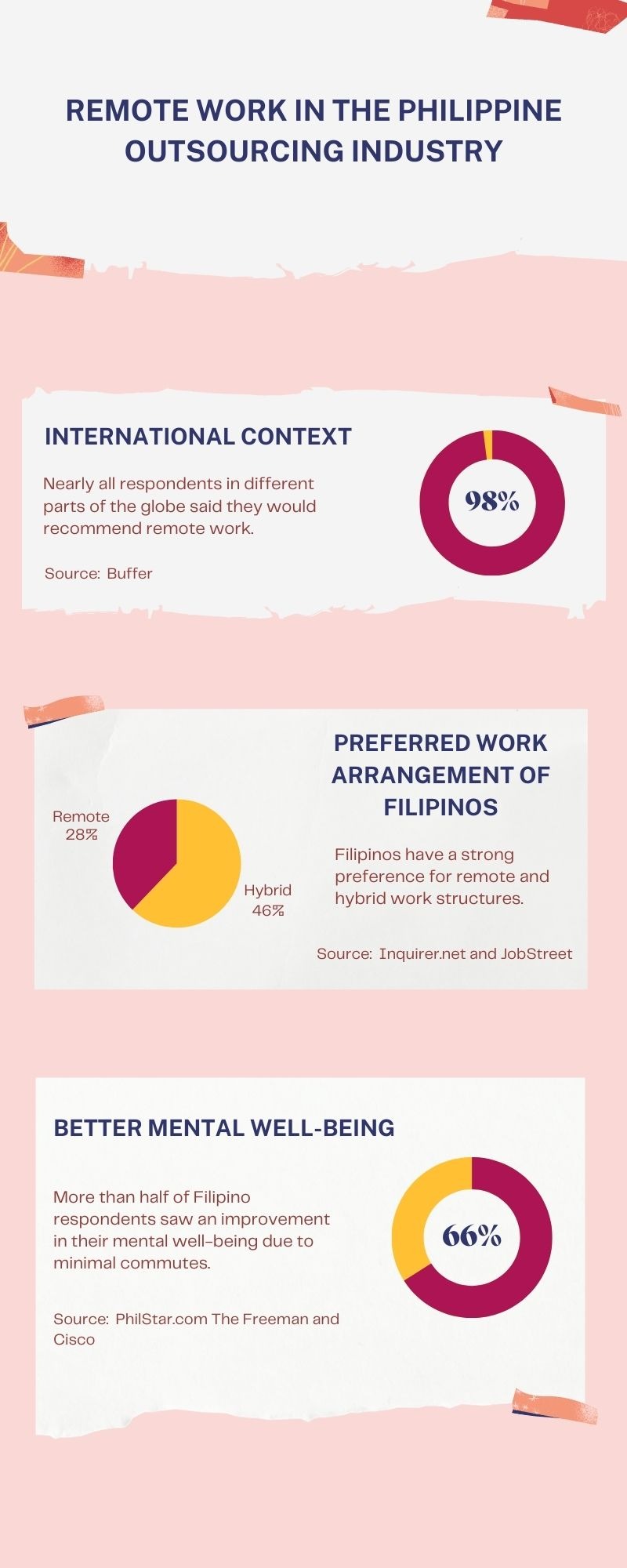
School closures, massive layoffs, loss of life, and the digital divide. There’s no denying the profound impact the COVID-19 pandemic left on everyone’s lives. On a positive note, though, the health crisis served as an awakening for many in the workforce, with businesses shifting to remote work and recognizing its benefits to employees.
While not every job can be done remotely, the pandemic showed that most jobs can be accomplished from the comfort of one’s home. This section discusses the state of remote work in the Philippine outsourcing industry, from the COVID-19 to the post-pandemic era.
Due to financial losses brought by the COVID-19 crisis, many contracting companies and clients inevitably pulled from business process outsourcing (BPO) companies, placing 37.7% of employees on no-work-no-pay or floating status, which refers to the temporary suspension of work without termination. Because they were not given work, this arrangement left employees — especially breadwinners — without monetary compensation.
Despite the prevalence of unemployment in many sectors, the Philippine BPO industry stood strong amidst the COVID-19 pandemic. To ensure social distancing, strict compliance with quarantine measures, and business continuity, many Philippine offshore outsourcing companies implemented remote work arrangements, forcing employees to bring their office computers and peripherals to their homes.
Some offshore outsourcing firms even offered to send equipment or provide housing in apartments, hotels, or office premises so their employees could work properly. According to Philstar.com, citing the IT-Business Process Association of the Philippines (IBPAP), 58% of BPO employees worked in company-paid hotels or from their homes, while only 15% of BPO staff were included in the company’s skeletal workforce during Luzon’s enhanced community quarantine (ECQ).
Although outsourcing companies implemented automation and cloud technologies, the pandemic illuminated long-recurring challenges in the Philippines. One such challenge is stable internet connectivity, which is rooted in the country’s lackluster IT infrastructure. For some BPO employees, working remotely with poor internet connection was a hurdle, preventing them from completing tasks and maintaining optimal productivity.
Still, the Philippine BPO industry has remained a premier contributor to employment and growth, creating around 120,000 jobs from 2020 to 2021 and generating a revenue increase of 1.4%. In addition, the pandemic spurred the demand for outsourcing healthcare, retail, and financial services, allowing BPO companies in the Philippines to thrive during the crisis.
Despite the feasibility of remote work in the Philippine outsourcing industry, the return-to-office (RTO) mandate sparked an uproar among BPO employees. While the RTO mandate could help reignite pandemic-affected sectors and encourage spending and economic growth, the order came off as “inhumane” as an IT-BPO coalition group cited inadequate transportation and the “volatility” of the crisis for slamming the mandate, reported Philstar.com. According to Bienvenido Laguesma — the secretary of the Department of Labor and Employment (DOLE) — BPO employees must be consulted should companies require them to work on-site.
The pushback is understandable given that the Philippine BPO industry has fully integrated into the remote work set-up. Unsurprisingly, for seven in 10 Filipino employees who want to stay in their current company or apply to another one, it is a deal-breaker if they can’t permanently work hybrid or fully remote, reported Philstar.com The Freeman, citing the 2022–2023 Global Talent Trends study by Mercer.
Initially, the Philippine Economic Zone Authority (PEZA) extended Registered Business Enterprises (RBE) and IT-BPOs’ 70% in-office and 30% WFH arrangements to September 12, 2022. This decision, however, was reversed when the Department of Finance announced the extension of the WFH arrangement “until further notice.”
While BPO firms like KDCI Outsourcing have on-site, hybrid, and remote positions, an outsourcing partner must always be ready for change. To improve employees’ experience in remote work in the Philippine outsourcing industry, every BPO company must invest in automation and AI tools to streamline tedious processes and improve efficiency.
Because remote work poses a risk to data security, BPO companies must not only provide secure data privacy solutions but also educate employees on maintaining good cybersecurity hygiene. These hygiene practices include avoiding phishing scams, updating passwords and security software, and backing up files in the cloud.
Furthermore, with meetings being conducted online, BPO companies must provide videoconferencing tools that promote seamless collaboration between team members and clients. Likewise, remote team management is a vital skill that can’t be overlooked if team leaders and project coordinators want to hone their leadership acumen.
The BPO industry will continue to boom. The latest Philippine outsourcing statistics show that the outsourcing sector is projected to grow by 6% in 2025. With this in mind, BPO companies should look forward to a brighter future for the industry while futureproofing their operations and employees to ensure competitiveness.
There are a plethora of tools for remote work. Below is a short round-up of the best tools and software for this work arrangement. Maybe your company is using or has used most, if not, all of the following at some point!
This project management app is a staple of any offshore team. With this tool, you can create and assign task cards and set deadlines with a click of a button. The ability to create a project ensures that all tasks for every initiative are organized, accessible, and integrated into your daily workflow.
Moreover, Asana’s Rule feature minimizes human input for certain actions. By using its recommended rules or creating your own rules, your outsourcing team can enjoy top-tier efficiency and optimize project management. Using ClickUp and Trello for project management are also good alternatives to Asana.
Gmail, Google Docs, Google Sheets, and many more are every remote worker’s go-to tools. Google products are available on multiple platforms, making it easy to send emails, edit documents and spreadsheets, and share files on the go with your phone or computer.
Microsoft Teams, or MS Teams, is another popular program for remote employees and Philippine BPOs. It boasts a whole suite of features, including an integrated calendar for checking virtual meeting schedules and responding to meeting invites as well as a One Drive directory for accessing Microsoft files.
What’s more, you can add Dropbox and other apps to streamline workflow and enable seamless engagement with colleagues. While MS Teams involves a slight learning curve for newcomers, its functionality and unique features make it a better alternative to Skype.
Slack is a platform designed to optimize communication between remote employees and clients. Although it has the standard features of messaging and videoconferencing platforms, the tool’s Slack AI is its best feature.
Slack AI is your handy AI-powered partner; it provides summaries of conversations, so employees won’t miss any team updates and announcements. During virtual meetings, Slack AI does the tedious work of note-taking for you. This way, you can listen to the meeting with all ears. Large enterprises and small businesses also use Slack, so consider using this software if you need an all-in-one AI-powered tool.
Canva is a graphic design tool not just for offshore outsourcing creative teams, but also for Filipino remote workers who have little graphic design experience. From its catalog of templates, you can create presentations, infographics, marketing materials, brochures, and other visual content for social media, blog articles, and the like.
Canva also has stock photos and an AI image generator for your design needs. With its intuitive interface and drag-and-drop elements, Canva is a user-friendly tool for anyone in the Philippine BPO industry and beyond.
The pandemic proved one thing: the feasibility of remote work. In the Philippines, the pros outweigh the cons. Filipino remote workers dedicate more time to themselves, spend less money on food and transportation, and enjoy heightened productivity levels.
At KDCI Outsourcing, our remote team of Filipino professionals — who underwent a rigorous remote employee screening process — works round-the-clock to provide you with cost-effective, high-quality services from the comfort of their homes. Whether you prefer communicating on Slack or delegating tasks on Asana, we use the same tools as your business for smooth collaboration.
Need remote staffing solutions for your outsourced business operations? Contact us now for inquiries.


What started out as a few agents, has grown into an invaluable partnership with KDCI. With more than 40 team members, we are lucky enough to count as part of our Cedar Family. Thank you so much KDCI for making our Company better!

We have found KDCI to be a consistently reliable partner, always willing to ‘go the extra mile’ to ensure our valued customers receive the best possible service.

KDCI plays a very important role in our catalog and content operations. They are responsive, kind, and always willing to help us as much as possible. We have been working together for more than 4 years, and we hope our partnership will be even more fruitful in the future.

Having collaborated with KDCI.co for our creative needs, I can confidently attest to their unparalleled expertise and dedication. Their team consistently delivered innovative solutions that not only met, but often exceeded our expectations. Their professionalism and attention to detail are commendable.

KDCI were able to grow with us with any future requirements. We have a lot to do when it comes to our business, and everytime we come back, they're right there with us and able to deliver.

KDCI's team has been instrumental in helping us not only modernize our platforms but also increase the experiences for the customer, and to deliver on the tsunami of content that came their way.

We had a lot of difficulty finding qualified talent in the United States. Honestly, I don't think we had thought about outsourcing at all as a potential option, but we were very open to it once we heard about it. We love our KDCI team. They're just like a regular part of our team, it's just that they're thousands of miles away.

It's been five years since we started working with KDCI, and it just keeps getting better and better. We've grown together and achieved a lot of shared success. Overall, they're incredibly professional yet fun to work with. We are incredibly happy to have found them.

We're so glad we partnered with KDCI to develop a unique platform that delivers personalized customer experiences without compromising functionality or security. It was an amazing experience, I won't hesitate to start another project with them again.